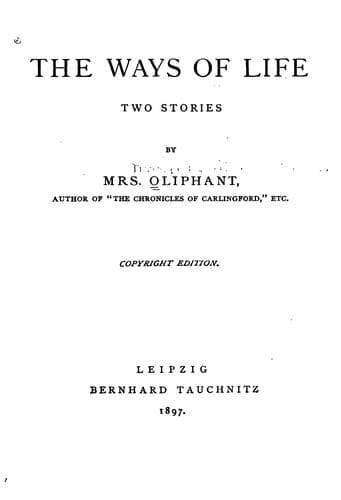
The Ways of Life: Two StoriesOliphant, Mrs. (Margaret)
General
The Ways of Life: Two Stories
Oliphant, Mrs. (Margaret)
Fiction
These problems of the common life, though they are perhaps less
cheerful, are surely as fit subjects for fiction as are the easier
difficulties of youth. It is common to say that all the stories have
been told and every complication exhausted, so that we can do nothing
but repeat the old themes over again, with such variety of treatment as
our halting genius can suggest. Romance itself, they say, is gone, which
is an assertion strenuously contradicted by the most powerful of our
young writers, Mr. Rudyard Kipling, who replies to it in very energetic
tones, that, Here is a steam-engine, which is Romance incarnate, the
great poetry of form and purpose, a creation, as distinct as Hamlet or
Lear, a big, dutiful, but exigent giant which a touch can turn into a
destroyer, but loving guidance into the most useful servant and friend
of man. The tramp of its mighty feet across the wastes of the sea,
bringing the man home to his wife, the son to his mother, is poetry, is
joy to this eager spirit. I am disposed in moderation to accept the
belief of the young author who has a most broad and manful perception of
life as something more than love-making, and to acknowledge the
mysterious monstrous thing which he makes heroic. To show in his
masterful way how every consenting part of the big machine as it clanks
on with large unwieldy steps, so many beats to a minute, sounds a note
in the symphony of life and service, a voice in the great strain of song
which rises from earth to heaven, is more worthy than all the unsavoury
romances of all the decadents. Would not St. Francis, had he lived to
see it, have called to Brother Iron and Brother Steel, strong henchmen
of God, and Sister Steam, with her wreaths of snow, though her voice be
not sweet, to join the song of the Creatures in honour of the Maker, as
he called upon fire and water in his famous hymn? or that older minstrel
in the ancient ages, to whom “snow and vapour, wind and storms
fulfilling His word,” were already members of the great choir? It must
be added, however, when all is said, that it is the grimy engineer
behind watching every valve and guiding every stroke who makes the
romance of the machine, as interesting in his way as Romeo, who, though
he is the perennial hero, and attracts the greatest general interest, is
not so much of a man.
Public-domain text, read in full here on John Shaqi.
Reviews
Reviews
No reviews yet
Be the first to share your thoughts on this work.
Join the Discussion
Join the discussion
Sign in to leave a comment or review.
Sign InorCreate an account