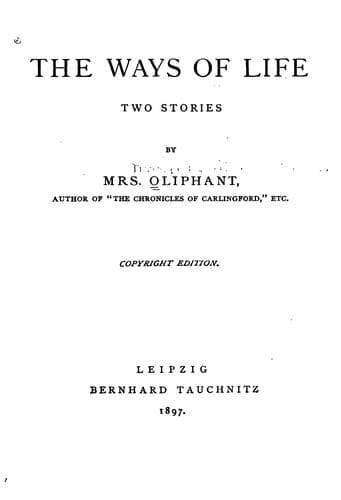
The Ways of Life: Two StoriesOliphant, Mrs. (Margaret)
General
The Ways of Life: Two Stories
Oliphant, Mrs. (Margaret)
Fiction
says Wordsworth. “We have wrought no deliverance in the earth,” says
with profounder meaning a much older poet. A man in such straits may
sometimes save himself as Hamlet would have done, with a bare bodkin,
had not the thought of that something after death which might be worse
even than present calamity deterred him; but if he is of other mettle
and cannot run away, or leave his post save at the lawful summons, the
question, What he is to do? is overwhelming. No hope of being carried to
any island valley of Avillion by stately queens in that boat which is
going out with the tide. And no rebellion against fate will do him the
slightest service. He has to hold his footing somehow--but how?
I confess that I have not had the courage to follow this question, in
either of the cases treated here, to such depths of human discomfiture
as may have been, or may yet be. A greater artist might have done so,
and led the defeated man through all the depths of humiliation and
dismay; but my hand is not strong or firm enough to trace out to the
bounds of the catastrophe the last possibilities of the broken career.
What in the jargon of the age is called the psychological moment is
that in which the first discovery is made, and the startled victim
suddenly perceives what has happened to him, and feels in every plank of
his boat the downward drag of the ebb tide, and looks about him wildly
to see if there is anything he can lay hold of to arrest it, any
deliverance or any escape. This is the case of Mr. Sandford, the hero of
the first of the following tales: and of many others who are not
favoured by so speedy and so complete an answer to this bewildering
problem of life.
The other story is different; for Robert Dalyell, the subject of that,
has laid his plans arbitrarily to escape out of it, doing what seems to
him the best he can for those who belonged to him. And here again there
is much more to say than has been said; for the condition of the man who
blots himself out of life without dying, and accepts a kind of moral
annihilation while yet all the sources of life are warm within him,
might well afford us one of the most tragic chapters of human history.
But I have shrunk from those darker colours with a compunction for him
whom I have made to suffer, which is quite fantastical and out of
reason, but yet true. To have brought him into the world for the mere
purpose of exhibiting his torments seems bad enough without searching
into the depths of them, and betraying those secrets which he himself
accepts with a robust commonplace of endurance as the natural
consequences of the step he has taken.
Public-domain text, read in full here on John Shaqi.
Reviews
Reviews
No reviews yet
Be the first to share your thoughts on this work.
Join the Discussion
Join the discussion
Sign in to leave a comment or review.
Sign InorCreate an account