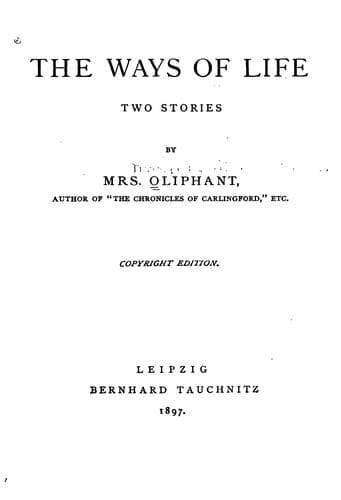
The Ways of Life: Two StoriesOliphant, Mrs. (Margaret)
General
The Ways of Life: Two Stories
Oliphant, Mrs. (Margaret)
Fiction
I have wondered often whether Macaulay and Darwin, and such great men,
whom it is the pride of the novel writer to quote as finding their
recreation in novels, were not of my opinion; though it is sadly
disconcerting to find from his own account that all Mr. Darwin wanted
was a story which ended happily--a judgment which is humbling to one’s
pride in a reader of whom one was so much inclined to boast. So do I
like a story which ends happily. And since the public is fond of such
small revelations, I may here confess that I have often begun a story
with the determination to be high-minded--to treat my young lovers
without indulgence, and either kill them or part them in deference to
the rules of Art. But my heart has generally failed me, and I have
rarely found courage to do them any harm. They will have plenty of
trouble in the world, one knows--why should one cross them in the
beginning of their career?
These, however, are questions of a lighter mood than the one with which
I began, and a manifest digression from that theme. The two stories
which follow treat not of the joy and pride of life, but of those so
often unforeseen misfortunes and accidents which shape it towards its
end. Life appears under a very different aspect to the man who has felt
the turn of the tide. Probably the discovery has been quite sudden,
startling, and, so far as he knows, private to himself. His friends all
the time may go on hailing him as poet, creator--all manner of fine
things. If he discloses his discovery to them, he is met by reproaches
for his dejection, his distrust and gloomy views; the compliments which
he knows so well and believes so little are heaped again upon him; he is
out of health, out of spirits, overworked, they say, in want of rest; a
few weeks leisure and repose, and he will be himself again--as if it
were a mood or a freak of temper, and not a fact staring him in the
face. But usually he is too much stunned to speak. He is not dying, or
like to die, though his career has come or is coming to an end. It would
be far more appropriate, far more dramatic if he were; but death is
illogical, and will seldom come at the moment when it is wanted, when it
would most appropriately solve the problem of what is to be done
after?--which becomes the most pressing, the most necessary of
questions. Why did not Napoleon die at Waterloo? He lived to add a
pitiful postscript to his existence, to accumulate all kinds of squalid
miseries about his end, instead of the dramatic and clear-cut conclusion
which he might have attained by a merciful bullet or the thrust of a
bayonet. And how well it would be to end thus when we have discovered
that our day is over! But so far from that, the man has to go on, as if
nothing had happened, “in a cheerful despair,” as I have read in a
note-book--as if to-day were as yesterday, or perhaps more abundant.
“We poets in our youth, begin in gladness,
But after comes in the end despondency and madness,”
Public-domain text, read in full here on John Shaqi.
Reviews
Reviews
No reviews yet
Be the first to share your thoughts on this work.
Join the Discussion
Join the discussion
Sign in to leave a comment or review.
Sign InorCreate an account