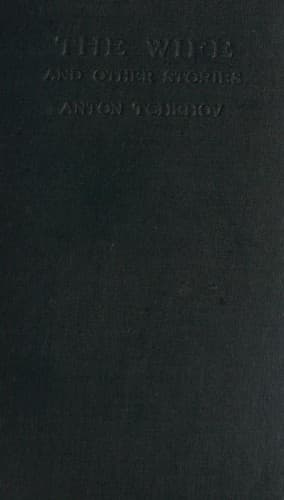
The Wife, and Other StoriesChekhov, Anton Pavlovich
General
The Wife, and Other Stories
Chekhov, Anton Pavlovich
Chekhov, Anton Pavlovich, 1860-1904 -- Translations into English; Russia -- Social life and customs -- Fiction; Short stories
My wife, Natalya Gavrilovna, lived on the lower storey, all the rooms of
which she occupied. She slept, had her meals, and received her visitors
downstairs in her own rooms, and took not the slightest interest in how
I dined, or slept, or whom I saw. Our relations with one another were
simple and not strained, but cold, empty, and dreary as relations are
between people who have been so long estranged, that even living under
the same roof gives no semblance of nearness. There was no trace now of
the passionate and tormenting love--at one time sweet, at another bitter
as wormwood--which I had once felt for Natalya Gavrilovna. There
was nothing left, either, of the outbursts of the past--the loud
altercations, upbraidings, complaints, and gusts of hatred which had
usually ended in my wife’s going abroad or to her own people, and in my
sending money in small but frequent instalments that I might sting her
pride oftener. (My proud and sensitive wife and her family live at my
expense, and much as she would have liked to do so, my wife could not
refuse my money: that afforded me satisfaction and was one comfort in
my sorrow.) Now when we chanced to meet in the corridor downstairs or in
the yard, I bowed, she smiled graciously. We spoke of the weather, said
that it seemed time to put in the double windows, and that some one with
bells on their harness had driven over the dam. And at such times I read
in her face: “I am faithful to you and am not disgracing your good name
which you think so much about; you are sensible and do not worry me; we
are quits.”
I assured myself that my love had died long ago, that I was too much
absorbed in my work to think seriously of my relations with my wife.
But, alas! that was only what I imagined. When my wife talked aloud
downstairs I listened intently to her voice, though I could not
distinguish one word. When she played the piano downstairs I stood up
and listened. When her carriage or her saddlehorse was brought to the
door, I went to the window and waited to see her out of the house; then
I watched her get into her carriage or mount her horse and ride out of
the yard. I felt that there was something wrong with me, and was afraid
the expression of my eyes or my face might betray me. I looked after my
wife and then watched for her to come back that I might see again
from the window her face, her shoulders, her fur coat, her hat. I felt
dreary, sad, infinitely regretful, and felt inclined in her absence to
walk through her rooms, and longed that the problem that my wife and
I had not been able to solve because our characters were incompatible,
should solve itself in the natural way as soon as possible--that is,
that this beautiful woman of twenty-seven might make haste and grow old,
and that my head might be grey and bald.
One day at lunch my bailiff informed me that the Pestrovo peasants
had begun to pull the thatch off the roofs to feed their cattle. Marya
Gerasimovna looked at me in alarm and perplexity.
Public-domain text, read in full here on John Shaqi.
Reviews
Reviews
No reviews yet
Be the first to share your thoughts on this work.
Join the Discussion
Join the discussion
Sign in to leave a comment or review.
Sign InorCreate an account