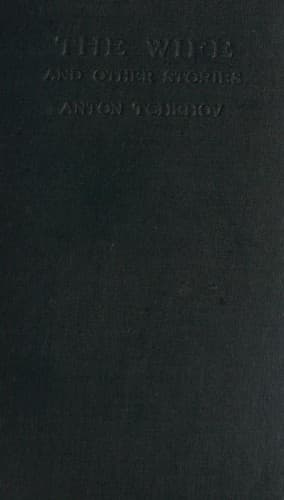
The Wife, and Other StoriesChekhov, Anton Pavlovich
General
The Wife, and Other Stories
Chekhov, Anton Pavlovich
Chekhov, Anton Pavlovich, 1860-1904 -- Translations into English; Russia -- Social life and customs -- Fiction; Short stories
“What can I do?” I said to her. “One cannot fight single-handed, and I
have never experienced such loneliness as I do now. I would give a great
deal to find one man in the whole province on whom I could rely.”
“Invite Ivan Ivanitch,” said Marya Gerasimovna.
“To be sure!” I thought, delighted. “That is an idea! _C’est raison_,”
I hummed, going to my study to write to Ivan Ivanitch. “_C’est raison,
c’est raison_.”
II
Of all the mass of acquaintances who, in this house twenty-five to
thirty-five years ago, had eaten, drunk, masqueraded, fallen in love,
married, bored us with accounts of their splendid packs of hounds and
horses, the only one still living was Ivan Ivanitch Bragin. At one time
he had been very active, talkative, noisy, and given to falling in love,
and had been famous for his extreme views and for the peculiar charm of
his face, which fascinated men as well as women; now he was an old man,
had grown corpulent, and was living out his days with neither views nor
charm. He came the day after getting my letter, in the evening just
as the samovar was brought into the dining-room and little Marya
Gerasimovna had begun slicing the lemon.
“I am very glad to see you, my dear fellow,” I said gaily, meeting him.
“Why, you are stouter than ever....”
“It isn’t getting stout; it’s swelling,” he answered. “The bees must
have stung me.”
With the familiarity of a man laughing at his own fatness, he put his
arms round my waist and laid on my breast his big soft head, with the
hair combed down on the forehead like a Little Russian’s, and went off
into a thin, aged laugh.
“And you go on getting younger,” he said through his laugh. “I wonder
what dye you use for your hair and beard; you might let me have some of
it.” Sniffing and gasping, he embraced me and kissed me on the cheek.
“You might give me some of it,” he repeated. “Why, you are not forty,
are you?”
“Alas, I am forty-six!” I said, laughing.
Ivan Ivanitch smelt of tallow candles and cooking, and that suited him.
His big, puffy, slow-moving body was swathed in a long frock-coat like a
coachman’s full coat, with a high waist, and with hooks and eyes
instead of buttons, and it would have been strange if he had smelt of
eau-de-Cologne, for instance. In his long, unshaven, bluish double chin,
which looked like a thistle, his goggle eyes, his shortness of breath,
and in the whole of his clumsy, slovenly figure, in his voice, his
laugh, and his words, it was difficult to recognize the graceful,
interesting talker who used in old days to make the husbands of the
district jealous on account of their wives.
“I am in great need of your assistance, my friend,” I said, when we were
sitting in the dining-room, drinking tea. “I want to organize relief for
the starving peasants, and I don’t know how to set about it. So perhaps
you will be so kind as to advise me.”
“Yes, yes, yes,” said Ivan Ivanitch, sighing. “To be sure, to be sure,
to be sure....”
Public-domain text, read in full here on John Shaqi.
Reviews
Reviews
No reviews yet
Be the first to share your thoughts on this work.
Join the Discussion
Join the discussion
Sign in to leave a comment or review.
Sign InorCreate an account