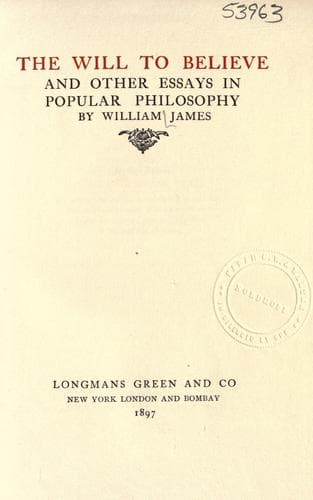
The Will to Believe, and Other Essays in Popular PhilosophyJames, William
Religion
The Will to Believe, and Other Essays in Popular Philosophy
James, William
Belief and doubt; Essays; Philosophy
Produced by Al Haines. (This file was produced from images
generously made available by The Internet Archive.)
THE WILL TO BELIEVE
AND OTHER ESSAYS IN
POPULAR PHILOSOPHY
BY WILLIAM JAMES
NEW IMPRESSION
LONGMANS, GREEN, AND CO.
FOURTH AVENUE & 30TH STREET, NEW YORK
LONDON, BOMBAY, AND CALCUTTA
1912
_Copyright, 1896_
BY WILLIAM JAMES
First Edition. February, 1897,
Reprinted, May, 1897, September, 1897,
March, 1898, August, 1899, June, 1902,
January, 1903, May, 1904, June, 1905,
March, 1907, April, 1908,
September, 1909, December, 1910,
November, 1911, November, 1912
To
My Old Friend,
CHARLES SANDERS PEIRCE,
To whose philosophic comradeship in old times
and to whose writings in more recent years
I owe more incitement and help than
I can express or repay.
{vii}
PREFACE.
At most of our American Colleges there are Clubs formed by the students
devoted to particular branches of learning; and these clubs have the
laudable custom of inviting once or twice a year some maturer scholar
to address them, the occasion often being made a public one. I have
from time to time accepted such invitations, and afterwards had my
discourse printed in one or other of the Reviews. It has seemed to me
that these addresses might now be worthy of collection in a volume, as
they shed explanatory light upon each other, and taken together express
a tolerably definite philosophic attitude in a very untechnical way.
Were I obliged to give a short name to the attitude in question, I
should call it that of _radical empiricism_, in spite of the fact that
such brief nicknames are nowhere more misleading than in philosophy. I
say 'empiricism,' because it is contented to regard its most assured
conclusions concerning matters of fact as hypotheses liable to
modification in the course of future experience; and I say 'radical,'
because it treats the doctrine of monism itself as an hypothesis, and,
{viii} unlike so much of the half-way empiricism that is current under
the name of positivism or agnosticism or scientific naturalism, it does
not dogmatically affirm monism as something with which all experience
has got to square. The difference between monism and pluralism is
perhaps the most pregnant of all the differences in philosophy. _Primâ
facie_ the world is a pluralism; as we find it, its unity seems to be
that of any collection; and our higher thinking consists chiefly of an
effort to redeem it from that first crude form. Postulating more unity
than the first experiences yield, we also discover more. But absolute
unity, in spite of brilliant dashes in its direction, still remains
undiscovered, still remains a _Grenzbegriff_. "Ever not quite" must be
the rationalistic philosopher's last confession concerning it. After
all that reason can do has been done, there still remains the opacity
of the finite facts as merely given, with most of their peculiarities
mutually unmediated and unexplained.
Public-domain text, read in full here on John Shaqi.
Reviews
Reviews
No reviews yet
Be the first to share your thoughts on this work.
Join the Discussion
Join the discussion
Sign in to leave a comment or review.
Sign InorCreate an account