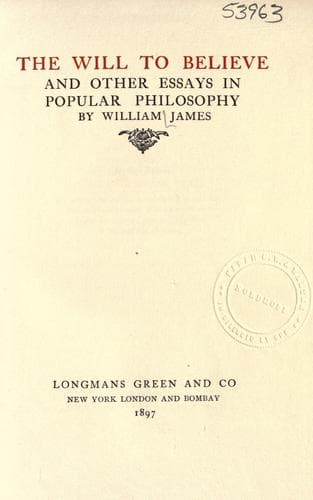
The Will to Believe, and Other Essays in Popular PhilosophyJames, William
Religion
The Will to Believe, and Other Essays in Popular Philosophy
James, William
Belief and doubt; Essays; Philosophy
To the very last, there are the
various 'points of view' which the philosopher must distinguish in
discussing the world; and what is inwardly clear from one point remains
a bare externality and datum to the other. The negative, the alogical,
is never wholly banished. Something--"call it fate, chance, freedom,
spontaneity, the devil, what you will"--is still wrong and other and
outside and unincluded, from _your_ point of view, even though you be
the greatest of philosophers. Something is always mere fact and
_givenness_; and there may be in the whole universe no one point of
view extant from which this would not be found to be the case.
"Reason," as a gifted writer says, "is {ix} but one item in the
mystery; and behind the proudest consciousness that ever reigned,
reason and wonder blushed face to face. The inevitable stales, while
doubt and hope are sisters. Not unfortunately the universe is
wild,--game-flavored as a hawk's wing. Nature is miracle all; the same
returns not save to bring the different. The slow round of the
engraver's lathe gains but the breadth of a hair, but the difference is
distributed back over the whole curve, never an instant true,--ever not
quite."[1]
This is pluralism, somewhat rhapsodically expressed. He who takes for
his hypothesis the notion that it is the permanent form of the world is
what I call a radical empiricist. For him the crudity of experience
remains an eternal element thereof. There is no possible point of view
from which the world can appear an absolutely single fact. Real
possibilities, real indeterminations, real beginnings, real ends, real
evil, real crises, catastrophes, and escapes, a real God, and a real
moral life, just as common-sense conceives these things, may remain in
empiricism as conceptions which that philosophy gives up the attempt
either to 'overcome' or to reinterpret in monistic form.
Many of my professionally trained _confrères_ will smile at the
irrationalism of this view, and at the artlessness of my essays in
point of technical form. But they should be taken as illustrations of
the radically empiricist attitude rather than as argumentations for its
validity. That admits meanwhile of {x} being argued in as technical a
shape as any one can desire, and possibly I may be spared to do later a
share of that work. Meanwhile these essays seem to light up with a
certain dramatic reality the attitude itself, and make it visible
alongside of the higher and lower dogmatisms between which in the pages
of philosophic history it has generally remained eclipsed from sight.
Public-domain text, read in full here on John Shaqi.
Reviews
Reviews
No reviews yet
Be the first to share your thoughts on this work.
Join the Discussion
Join the discussion
Sign in to leave a comment or review.
Sign InorCreate an account