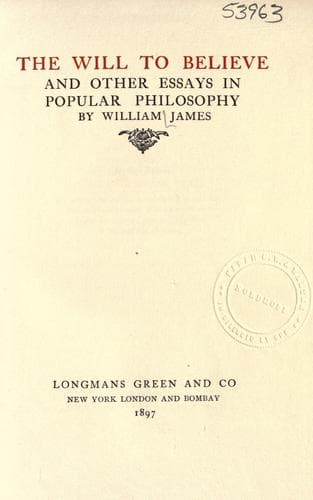
The Will to Believe, and Other Essays in Popular PhilosophyJames, William
Religion
The Will to Believe, and Other Essays in Popular Philosophy
James, William
Belief and doubt; Essays; Philosophy
Well, a vast number of our moral perceptions also are certainly of this
secondary and brain-born kind. They deal with directly felt fitnesses
between things, and often fly in the teeth of all the prepossessions of
habit and presumptions of utility. The moment you get beyond the
coarser and more commonplace moral maxims, the Decalogues and Poor
Richard's Almanacs, you fall into schemes and positions which to the
eye of common-sense are fantastic and overstrained. The sense for
abstract justice which some persons have is as excentric a variation,
from the natural-history point of view, as is the passion for music or
for the higher philosophical consistencies which consumes the soul of
others. The feeling of the inward dignity of certain spiritual
attitudes, as peace, serenity, simplicity, veracity; and of the
essential vulgarity of others, as querulousness, anxiety, egoistic
fussiness, etc.,--are quite inexplicable except by an innate preference
of the more ideal attitude for its own pure sake. The nobler thing
_tastes_ better, and that is all that we can say. {188} 'Experience'
of consequences may truly teach us what things are _wicked_, but what
have consequences to do with what is _mean_ and _vulgar_? If a man has
shot his wife's paramour, by reason of what subtile repugnancy in
things is it that we are so disgusted when we hear that the wife and
the husband have made it up and are living comfortably together again?
Or if the hypothesis were offered us of a world in which Messrs.
Fourier's and Bellamy's and Morris's Utopias should all be outdone, and
millions kept permanently happy on the one simple condition that a
certain lost soul on the far-off edge of things should lead a life of
lonely torture, what except a specifical and independent sort of
emotion can it be which would make us immediately feel, even though an
impulse arose within us to clutch at the happiness so offered, how
hideous a thing would be its enjoyment when deliberately accepted as
the fruit of such a bargain? To what, once more, but subtile
brain-born feelings of discord can be due all these recent protests
against the entire race-tradition of retributive justice?--I refer to
Tolstoi with his ideas of non-resistance, to Mr. Bellamy with his
substitution of oblivion for repentance (in his novel of Dr.
Heidenhain's Process), to M. Guyau with his radical condemnation of the
punitive ideal. All these subtileties of the moral sensibility go as
much beyond what can be ciphered out from the 'laws of association' as
the delicacies of sentiment possible between a pair of young lovers go
beyond such precepts of the 'etiquette to be observed during
engagement' as are printed in manuals of social form.
Public-domain text, read in full here on John Shaqi.
Reviews
Reviews
No reviews yet
Be the first to share your thoughts on this work.
Elsewhere in the archive
Join the Discussion
Join the discussion
Sign in to leave a comment or review.
Sign InorCreate an account