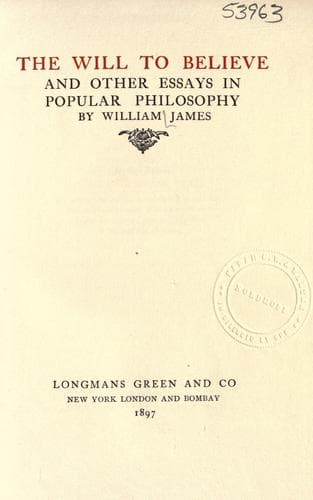
The Will to Believe, and Other Essays in Popular PhilosophyJames, William
Religion
The Will to Believe, and Other Essays in Popular Philosophy
James, William
Belief and doubt; Essays; Philosophy
If we must talk impersonally, to be sure we can say {196} that 'the
universe' requires, exacts, or makes obligatory such or such an action,
whenever it expresses itself through the desires of such or such a
creature. But it is better not to talk about the universe in this
personified way, unless we believe in a universal or divine
consciousness which actually exists. If there be such a consciousness,
then its demands carry the most of obligation simply because they are
the greatest in amount. But it is even then not _abstractly right_
that we should respect them. It is only concretely right,--or right
after the fact, and by virtue of the fact, that they are actually made.
Suppose we do not respect them, as seems largely to be the case in this
queer world. That ought not to be, we say; that is wrong. But in what
way is this fact of wrongness made more acceptable or intelligible when
we imagine it to consist rather in the laceration of an _à priori_
ideal order than in the disappointment of a living personal God? Do
we, perhaps, think that we cover God and protect him and make his
impotence over us less ultimate, when we back him up with this _à
priori_ blanket from which he may draw some warmth of further appeal?
But the only force of appeal to _us_, which either a living God or an
abstract ideal order can wield, is found in the 'everlasting ruby
vaults' of our own human hearts, as they happen to beat responsive and
not irresponsive to the claim. So far as they do feel it when made by
a living consciousness, it is life answering to life. A claim thus
livingly acknowledged is acknowledged with a solidity and fulness which
no thought of an 'ideal' backing can render more complete; while if, on
the other hand, the heart's response is withheld, the stubborn
phenomenon is there of an impotence in the claims {197} which the
universe embodies, which no talk about an eternal nature of things can
gloze over or dispel. An ineffective _à priori_ order is as impotent a
thing as an ineffective God; and in the eye of philosophy, it is as
hard a thing to explain.
We may now consider that what we distinguished as the metaphysical
question in ethical philosophy is sufficiently answered, and that we
have learned what the words 'good,' 'bad,' and 'obligation' severally
mean. They mean no absolute natures, independent of personal support.
They are objects of feeling and desire, which have no foothold or
anchorage in Being, apart from the existence of actually living minds.
Public-domain text, read in full here on John Shaqi.
Reviews
Reviews
No reviews yet
Be the first to share your thoughts on this work.
Elsewhere in the archive
Join the Discussion
Join the discussion
Sign in to leave a comment or review.
Sign InorCreate an account