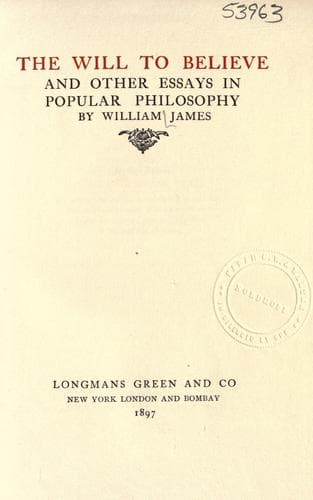
The Will to Believe, and Other Essays in Popular PhilosophyJames, William
Religion
The Will to Believe, and Other Essays in Popular Philosophy
James, William
Belief and doubt; Essays; Philosophy
What can he do, then, it will now be asked, except to fall back on
scepticism and give up the notion of being a philosopher at all?
{205}
But do we not already see a perfectly definite path of escape which is
open to him just because he is a philosopher, and not the champion of
one particular ideal? Since everything which is demanded is by that
fact a good, must not the guiding principle for ethical philosophy
(since all demands conjointly cannot be satisfied in this poor world)
be simply to satisfy at all times _as many demands as we can_? That
act must be the best act, accordingly, which makes for the best whole,
in the sense of awakening the least sum of dissatisfactions. In the
casuistic scale, therefore, those ideals must be written highest which
_prevail at the least cost_, or by whose realization the least possible
number of other ideals are destroyed. Since victory and defeat there
must be, the victory to be philosophically prayed for is that of the
more inclusive side,--of the side which even in the hour of triumph
will to some degree do justice to the ideals in which the vanquished
party's interests lay. The course of history is nothing but the story
of men's struggles from generation to generation to find the more and
more inclusive order. _Invent some manner_ of realizing your own
ideals which will also satisfy the alien demands,--that and that only
is the path of peace! Following this path, society has shaken itself
into one sort of relative equilibrium after another by a series of
social discoveries quite analogous to those of science. Polyandry and
polygamy and slavery, private warfare and liberty to kill, judicial
torture and arbitrary royal power have slowly succumbed to actually
aroused complaints; and though some one's ideals are unquestionably the
worse off for each improvement, yet a vastly greater total number of
them find shelter in our civilized society than in the older {206}
savage ways. So far then, and up to date, the casuistic scale is made
for the philosopher already far better than he can ever make it for
himself. An experiment of the most searching kind has proved that the
laws and usages of the land are what yield the maximum of satisfaction
to the thinkers taken all together. The presumption in cases of
conflict must always be in favor of the conventionally recognized good.
The philosopher must be a conservative, and in the construction of his
casuistic scale must put the things most in accordance with the customs
of the community on top.
Public-domain text, read in full here on John Shaqi.
Reviews
Reviews
No reviews yet
Be the first to share your thoughts on this work.
Elsewhere in the archive
Join the Discussion
Join the discussion
Sign in to leave a comment or review.
Sign InorCreate an account