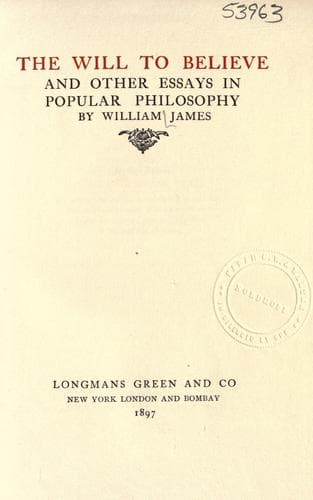
The Will to Believe, and Other Essays in Popular PhilosophyJames, William
Religion
The Will to Believe, and Other Essays in Popular Philosophy
James, William
Belief and doubt; Essays; Philosophy
And yet if he be a true philosopher he must see that there is nothing
final in any actually given equilibrium of human ideals, but that, as
our present laws and customs have fought and conquered other past ones,
so they will in their turn be overthrown by any newly discovered order
which will hush up the complaints that they still give rise to, without
producing others louder still. "Rules are made for man, not man for
rules,"--that one sentence is enough to immortalize Green's Prolegomena
to Ethics. And although a man always risks much when he breaks away
from established rules and strives to realize a larger ideal whole than
they permit, yet the philosopher must allow that it is at all times
open to any one to make the experiment, provided he fear not to stake
his life and character upon the throw. The pinch is always here. Pent
in under every system of moral rules are innumerable persons whom it
weighs upon, and goods which it represses; and these are always
rumbling and grumbling in the background, and ready for any issue by
which they may get free. See the abuses which the {207} institution of
private property covers, so that even to-day it is shamelessly asserted
among us that one of the prime functions of the national government is
to help the adroiter citizens to grow rich. See the unnamed and
unnamable sorrows which the tyranny, on the whole so beneficent, of the
marriage-institution brings to so many, both of the married and the
unwed. See the wholesale loss of opportunity under our _régime_ of
so-called equality and industrialism, with the drummer and the
counter-jumper in the saddle, for so many faculties and graces which
could flourish in the feudal world. See our kindliness for the humble
and the outcast, how it wars with that stern weeding-out which until
now has been the condition of every perfection in the breed. See
everywhere the struggle and the squeeze; and ever-lastingly the problem
how to make them less. The anarchists, nihilists, and free-lovers; the
free-silverites, socialists, and single-tax men; the free-traders and
civil-service reformers; the prohibitionists and anti-vivisectionists;
the radical darwinians with their idea of the suppression of the
weak,--these and all the conservative sentiments of society arrayed
against them, are simply deciding through actual experiment by what
sort of conduct the maximum amount of good can be gained and kept in
this world. These experiments are to be judged, not _à priori_, but by
actually finding, after the fact of their making, how much more outcry
or how much appeasement comes about. What closet-solutions can
possibly anticipate the result of trials made on such a scale? Or what
can any superficial theorist's judgment be worth, in a world where
every one of hundreds of ideals has its special champion already
provided {208} in the shape of some genius expressly born to feel it,
and to fight to death in its behalf? The pure philosopher can only
Public-domain text, read in full here on John Shaqi.
Reviews
Reviews
No reviews yet
Be the first to share your thoughts on this work.
Elsewhere in the archive
Join the Discussion
Join the discussion
Sign in to leave a comment or review.
Sign InorCreate an account