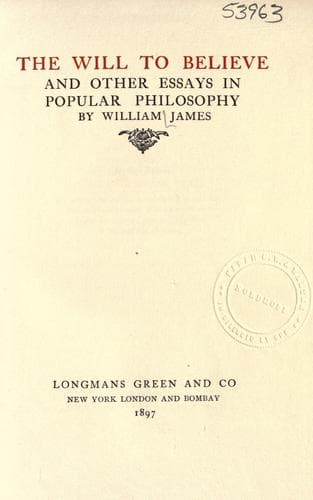
The Will to Believe, and Other Essays in Popular PhilosophyJames, William
Religion
The Will to Believe, and Other Essays in Popular Philosophy
James, William
Belief and doubt; Essays; Philosophy
follow the windings of the spectacle, confident that the line of least
resistance will always be towards the richer and the more inclusive
arrangement, and that by one tack after another some approach to the
kingdom of heaven is incessantly made.
IV.
All this amounts to saying that, so far as the casuistic question goes,
ethical science is just like physical science, and instead of being
deducible all at once from abstract principles, must simply bide its
time, and be ready to revise its conclusions from day to day. The
presumption of course, in both sciences, always is that the vulgarly
accepted opinions are true, and the right casuistic order that which
public opinion believes in; and surely it would be folly quite as
great, in most of us, to strike out independently and to aim at
originality in ethics as in physics. Every now and then, however, some
one is born with the right to be original, and his revolutionary
thought or action may bear prosperous fruit. He may replace old 'laws
of nature' by better ones; he may, by breaking old moral rules in a
certain place, bring in a total condition of things more ideal than
would have followed had the rules been kept.
On the whole, then, we must conclude that no philosophy of ethics is
possible in the old-fashioned absolute sense of the term. Everywhere
the ethical philosopher must wait on facts. The thinkers who create
the ideals come he knows not whence, their sensibilities are evolved he
knows not how; and the {209} question as to which of two conflicting
ideals will give the best universe then and there, can be answered by
him only through the aid of the experience of other men. I said some
time ago, in treating of the 'first' question, that the intuitional
moralists deserve credit for keeping most clearly to the psychological
facts. They do much to spoil this merit on the whole, however, by
mixing with it that dogmatic temper which, by absolute distinctions and
unconditional 'thou shalt nots,' changes a growing, elastic, and
continuous life into a superstitious system of relics and dead bones.
In point of fact, there are no absolute evils, and there are no
non-moral goods; and the _highest_ ethical life--however few may be
called to bear its burdens--consists at all times in the breaking of
rules which have grown too narrow for the actual case. There is but
one unconditional commandment, which is that we should seek
incessantly, with fear and trembling, so to vote and to act as to bring
about the very largest total universe of good which we can see.
Abstract rules indeed can help; but they help the less in proportion as
our intuitions are more piercing, and our vocation is the stronger for
the moral life. For every real dilemma is in literal strictness a
unique situation; and the exact combination of ideals realized and
ideals disappointed which each decision creates is always a universe
without a precedent, and for which no adequate previous rule exists.
Public-domain text, read in full here on John Shaqi.
Reviews
Reviews
No reviews yet
Be the first to share your thoughts on this work.
Elsewhere in the archive
Join the Discussion
Join the discussion
Sign in to leave a comment or review.
Sign InorCreate an account