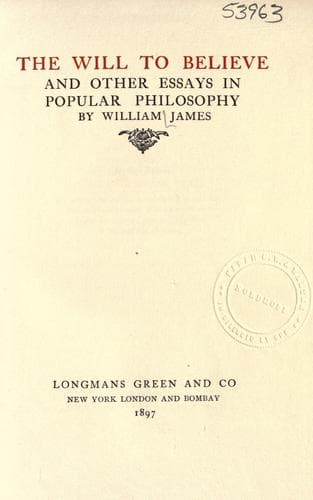
The Will to Believe, and Other Essays in Popular PhilosophyJames, William
Religion
The Will to Believe, and Other Essays in Popular Philosophy
James, William
Belief and doubt; Essays; Philosophy
Every painter can tell us how each added line deflects his picture in a
certain sense. Whatever lines follow must be built on those first laid
down. Every author who starts to rewrite a piece of work knows how
impossible it becomes to use any of the first-written pages again. The
new beginning has already excluded the possibility of those earlier
phrases and transitions, while it has at the same time created the
possibility of an indefinite set of new ones, no one of which, however,
is completely determined in advance. Just so the social surroundings
of the past and present hour exclude the possibility of accepting
certain contributions from individuals; but they do not positively
define what contributions shall be accepted, for in themselves they are
powerless to fix what the nature of the individual offerings shall
be.[6]
{232}
Thus social evolution is a resultant of the interaction of two wholly
distinct factors,--the individual, deriving his peculiar gifts from the
play of physiological and infra-social forces, but bearing all the
power of initiative and origination in his hands; and, second, the
social environment, with its power of adopting or rejecting both him
and his gifts. Both factors are essential to change. The community
stagnates without the impulse of the individual. The impulse dies away
without the sympathy of the community.
All this seems nothing more than common-sense. All who wish to see it
developed by a man of genius should read that golden little work,
Bagehot's Physics and Politics, in which (it seems to me) the complete
sense of the way in which concrete things grow and change is as
livingly present as the straining after a pseudo-philosophy of
evolution is livingly absent. But there are never wanting minds to
whom such views seem personal and contracted, and allied to an
anthropomorphism long exploded in other fields of knowledge. "The
individual withers, and the world is more and more," to these writers;
and in a Buckle, a Draper, and a Taine we all know how much the 'world'
has come to be almost synonymous with the _climate_. We all know, too,
how the controversy has been kept up between the partisans of a
'science of history' and those who deny the existence of anything like
necessary 'laws' where human societies are concerned. Mr. Spencer, at
the opening of his Study of Sociology, makes an onslaught on the
'great-man theory' of history, from which a few passages may be
quoted:--
Public-domain text, read in full here on John Shaqi.
Reviews
Reviews
No reviews yet
Be the first to share your thoughts on this work.
Elsewhere in the archive
Join the Discussion
Join the discussion
Sign in to leave a comment or review.
Sign InorCreate an account