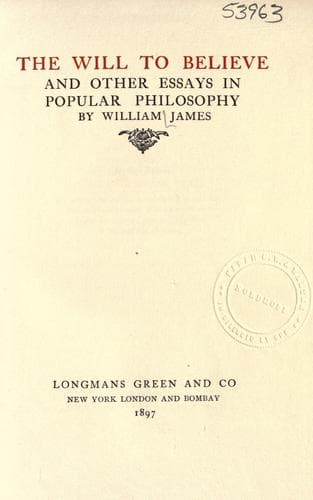
The Will to Believe, and Other Essays in Popular PhilosophyJames, William
Religion
The Will to Believe, and Other Essays in Popular Philosophy
James, William
Belief and doubt; Essays; Philosophy
"The genesis of societies by the action of great men may be comfortably
believed so long as, resting in general {233} notions, you do not ask
for particulars. But now, if, dissatisfied with vagueness, we demand
that our ideas shall be brought into focus and exactly defined, we
discover the hypothesis to be utterly incoherent. If, not stopping at
the explanation of social progress as due to the great man, we go back
a step, and ask, Whence comes the great man? we find that the theory
breaks down completely. The question has two conceivable answers: his
origin is supernatural, or it is natural. Is his origin supernatural?
Then he is a deputy god, and we have theocracy once removed,--or,
rather, not removed at all.... Is this an unacceptable solution? Then
the origin of the great man is natural; and immediately this is
recognized, he must be classed with all other phenomena in the society
that gave him birth as a product of its antecedents. Along with the
whole generation of which he forms a minute part, along with its
institutions, language, knowledge, manners, and its multitudinous arts
and appliances, he is a _resultant_.... You must admit that the
genesis of the great man depends on the long series of complex
influences which has produced the race in which he appears, and the
social state into which that race has slowly grown.... Before he can
remake his society, his society must make him. All those changes of
which he is the proximate initiator have their chief causes in the
generations he descended from. If there is to be anything like a real
explanation of those changes, it must be sought in that aggregate of
conditions out of which both he and they have arisen."[7]
Now, it seems to me that there is something which one might almost call
impudent in the attempt which Mr. Spencer makes, in the first sentence
of this extract, to pin the reproach of vagueness upon those who
believe in the power of initiative of the great man.
{234}
Suppose I say that the singular moderation which now distinguishes
social, political, and religious discussion in England, and contrasts
so strongly with the bigotry and dogmatism of sixty years ago, is
largely due to J. S. Mill's example. I may possibly be wrong about the
facts; but I am, at any rate, 'asking for particulars,' and not
'resting in general notions.' And if Mr. Spencer should tell me it
started from no personal influence whatever, but from the 'aggregate of
conditions,' the 'generations,' Mill and all his contemporaries
'descended from,' the whole past order of nature in short, surely he,
not I, would be the person 'satisfied with vagueness.'
Public-domain text, read in full here on John Shaqi.
Reviews
Reviews
No reviews yet
Be the first to share your thoughts on this work.
Elsewhere in the archive
Join the Discussion
Join the discussion
Sign in to leave a comment or review.
Sign InorCreate an account