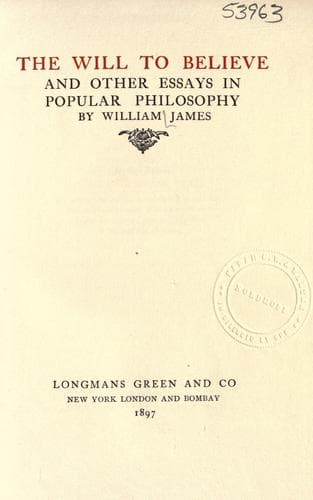
The Will to Believe, and Other Essays in Popular PhilosophyJames, William
Religion
The Will to Believe, and Other Essays in Popular Philosophy
James, William
Belief and doubt; Essays; Philosophy
The fact is that Mr. Spencer's sociological method is identical with
that of one who would invoke the zodiac to account for the fall of the
sparrow, and the thirteen at table to explain the gentleman's death.
It is of little more scientific value than the Oriental method of
replying to whatever question arises by the unimpeachable truism, "God
is great." _Not_ to fall back on the gods, where a proximate principle
may be found, has with us Westerners long since become the sign of an
efficient as distinguished from an inefficient intellect.
To believe that the cause of everything is to be found in its
antecedents is the starting-point, the initial postulate, not the goal
and consummation, of science. If she is simply to lead us out of the
labyrinth by the same hole we went in by three or four thousand years
ago, it seems hardly worth while to have followed her through the
darkness at all. If anything is humanly certain it is that the great
man's society, properly so called, does not make him before he can
remake it. Physiological forces, with which {235} the social,
political, geographical, and to a great extent anthropological
conditions have just as much and just as little to do as the condition
of the crater of Vesuvius has to do with the flickering of this gas by
which I write, are what make him. Can it be that Mr. Spencer holds the
convergence of sociological pressures to have so impinged on
Stratford-upon-Avon about the 26th of April, 1564, that a W.
Shakespeare, with all his mental peculiarities, had to be born
there,--as the pressure of water outside a certain boat will cause a
stream of a certain form to ooze into a particular leak? And does he
mean to say that if the aforesaid W. Shakespeare had died of cholera
infantum, another mother at Stratford-upon-Avon would needs have
engendered a duplicate copy of him, to restore the sociologic
equilibrium,--just as the same stream of water will reappear, no matter
how often you pass a sponge over the leak, so long as the outside level
remains unchanged? Or might the substitute arise at
'Stratford-atte-Bowe'? Here, as elsewhere, it is very hard, in the
midst of Mr. Spencer's vagueness, to tell what he does mean at all.
We have, however, in his disciple, Mr. Grant Allen, one who leaves us
in no doubt whatever of his precise meaning. This widely informed,
suggestive, and brilliant writer published last year a couple of
articles in the Gentleman's Magazine, in which he maintained that
individuals have no initiative in determining social change.
Public-domain text, read in full here on John Shaqi.
Reviews
Reviews
No reviews yet
Be the first to share your thoughts on this work.
Elsewhere in the archive
Join the Discussion
Join the discussion
Sign in to leave a comment or review.
Sign InorCreate an account