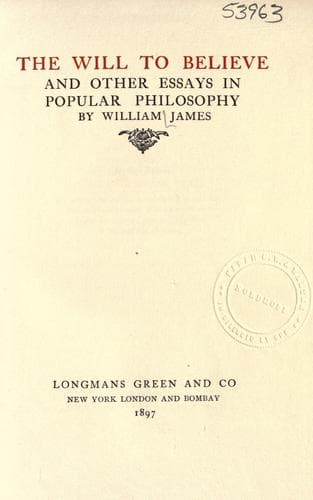
The Will to Believe, and Other Essays in Popular PhilosophyJames, William
Religion
The Will to Believe, and Other Essays in Popular Philosophy
James, William
Belief and doubt; Essays; Philosophy
Now, there is a striking law over which few people seem to have
pondered. It is this: That among all the differences which exist, the
only ones that interest us strongly are those _we do not take for
granted_. We are not a bit elated that our friend should have two
hands and the power of speech, and should practise the matter-of-course
human virtues; and quite as little are we vexed that our dog goes on
all fours and fails to understand our conversation. Expecting no more
from the latter companion, and no less from the former, we get what we
expect and are satisfied. We never think of communing with the dog by
discourse of philosophy, or with the friend by head-scratching or the
throwing of crusts to be snapped at. But if either dog or friend fall
above or below the expected standard, they arouse the most lively
emotion. On our brother's vices or genius we never weary of
descanting; to his bipedism or his hairless skin we do not consecrate a
thought. _What_ he says may transport us; that he is able to speak at
all leaves us stone cold. The reason of all this is that his virtues
and vices and utterances might, compatibly with the current range of
variation in our tribe, be just the opposites of what they are, while
his zoölogically human attributes cannot possibly go astray. There
{258} is thus a zone of insecurity in human affairs in which all the
dramatic interest lies; the rest belongs to the dead machinery of the
stage. This is the formative zone, the part not yet ingrained into the
race's average, not yet a typical, hereditary, and constant factor of
the social community in which it occurs. It is like the soft layer
beneath the bark of the tree in which all the year's growth is going
on. Life has abandoned the mighty trunk inside, which stands inert and
belongs almost to the inorganic world. Layer after layer of human
perfection separates me from the central Africans who pursued Stanley
with cries of "meat, meat!" This vast difference ought, on Mr. Allen's
principles, to rivet my attention far more than the petty one which
obtains between two such birds of a feather as Mr. Allen and myself.
Yet while I never feel proud that the sight of a passer-by awakens in
me no cannibalistic waterings of the mouth, I am free to confess that I
shall feel very proud if I do not publicly appear inferior to Mr. Allen
in the conduct of this momentous debate. To me as a teacher the
intellectual gap between my ablest and my dullest student counts for
infinitely more than that between the latter and the amphioxus: indeed,
I never thought of the latter chasm till this moment. Will Mr. Allen
seriously say that this is all human folly, and tweedledum and
tweedledee?
Public-domain text, read in full here on John Shaqi.
Reviews
Reviews
No reviews yet
Be the first to share your thoughts on this work.
Elsewhere in the archive
Join the Discussion
Join the discussion
Sign in to leave a comment or review.
Sign InorCreate an account