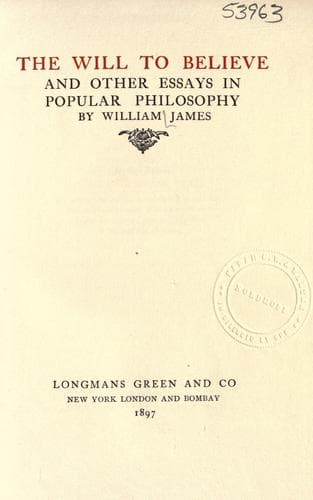
The Will to Believe, and Other Essays in Popular PhilosophyJames, William
Religion
The Will to Believe, and Other Essays in Popular Philosophy
James, William
Belief and doubt; Essays; Philosophy
To a Veddah's eyes the differences between two white literary men seem
slight indeed,--same clothes, same spectacles, same harmless
disposition, same habit of scribbling on paper and poring over books,
etc. "Just two white fellows," the Veddah will say, "with no
perceptible difference." But what a difference to the literary men
themselves! Think, Mr. Allen, of {259} confounding our philosophies
together merely because both are printed in the same magazines and are
indistinguishable to the eye of a Veddah! Our flesh creeps at the
thought.
But in judging of history Mr. Allen deliberately prefers to place
himself at the Veddah's point of view, and to see things _en gros_ and
out of focus, rather than minutely. It is quite true that there are
things and differences enough to be seen either way. But which are the
humanly important ones, those most worthy to arouse our interest,--the
large distinctions or the small? In the answer to this question lies
the whole divergence of the hero-worshippers from the sociologists. As
I said at the outset, it is merely a quarrel of emphasis; and the only
thing I can do is to state my personal reasons for the emphasis I
prefer.
The zone of the individual differences, and of the social 'twists'
which by common confession they initiate, is the zone of formative
processes, the dynamic belt of quivering uncertainty, the line where
past and future meet. It is the theatre of all we do not take for
granted, the stage of the living drama of life; and however narrow its
scope, it is roomy enough to lodge the whole range of human passions.
The sphere of the race's average, on the contrary, no matter how large
it may be, is a dead and stagnant thing, an achieved possession, from
which all insecurity has vanished. Like the trunk of a tree, it has
been built up by successive concretions of successive active zones.
The moving present in which we live with its problems and passions, its
individual rivalries, victories, and defeats, will soon pass over to
the majority and leave its small deposit on this static mass, to make
room for fresh actors and a newer play. {260} And though it may be
true, as Mr. Spencer predicts, that each later zone shall fatally be
narrower than its forerunners; and that when the ultimate lady-like
tea-table elysium of the Data of Ethics shall prevail, such questions
as the breaking of eggs at the large or the small end will span the
whole scope of possible human warfare,--still even in this shrunken and
enfeebled generation, _spatio aetatis defessa vetusto_, what eagerness
there will be! Battles and defeats will occur, the victors will be
glorified and the vanquished dishonored just as in the brave days of
yore, the human heart still withdrawing itself from the much it has in
safe possession, and concentrating all its passion upon those
evanescent possibilities of fact which still quiver in fate's scale.
Public-domain text, read in full here on John Shaqi.
Reviews
Reviews
No reviews yet
Be the first to share your thoughts on this work.
Elsewhere in the archive
Join the Discussion
Join the discussion
Sign in to leave a comment or review.
Sign InorCreate an account