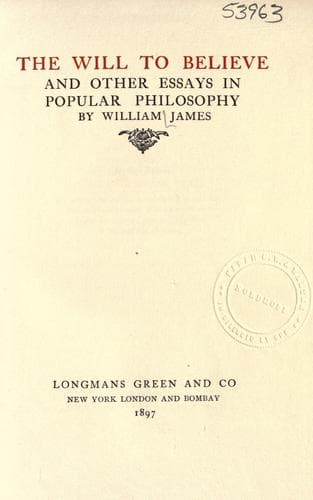
The Will to Believe, and Other Essays in Popular PhilosophyJames, William
Religion
The Will to Believe, and Other Essays in Popular Philosophy
James, William
Belief and doubt; Essays; Philosophy
Believe truth! Shun error!--these, we see, are two materially
different laws; and by choosing between them we may end by coloring
differently our whole intellectual life. We may regard the chase for
truth as paramount, and the avoidance of error as secondary; or we may,
on the other hand, treat the avoidance of error as more imperative, and
let truth take its chance. Clifford, in the instructive passage which
I have quoted, exhorts us to the latter course. Believe nothing, he
tells us, keep your mind in suspense forever, rather than by closing it
on insufficient evidence incur the awful risk of believing lies. You,
on the other hand, may think that the risk of being in error is a very
small matter when compared with the blessings of real knowledge, and be
ready to be duped many times in your investigation rather than postpone
indefinitely the chance of guessing true. I myself find it impossible
to go with Clifford. We must remember that these feelings of our duty
about either truth or error are in any case only expressions of our
passional life. Biologically considered, our minds are as ready to
grind out falsehood as veracity, and he who says, "Better go without
belief forever than believe a lie!" merely shows his own preponderant
private horror of becoming a dupe. He may be critical of many of his
desires and fears, but this fear he slavishly obeys. He cannot imagine
any one questioning its binding force. For my own part, I {19} have
also a horror of being duped; but I can believe that worse things than
being duped may happen to a man in this world: so Clifford's
exhortation has to my ears a thoroughly fantastic sound. It is like a
general informing his soldiers that it is better to keep out of battle
forever than to risk a single wound. Not so are victories either over
enemies or over nature gained. Our errors are surely not such awfully
solemn things. In a world where we are so certain to incur them in
spite of all our caution, a certain lightness of heart seems healthier
than this excessive nervousness on their behalf. At any rate, it seems
the fittest thing for the empiricist philosopher.
VIII.
And now, after all this introduction, let us go straight at our
question. I have said, and now repeat it, that not only as a matter of
fact do we find our passional nature influencing us in our opinions,
but that there are some options between opinions in which this
influence must be regarded both as an inevitable and as a lawful
determinant of our choice.
I fear here that some of you my hearers will begin to scent danger, and
lend an inhospitable ear. Two first steps of passion you have indeed
had to admit as necessary,--we must think so as to avoid dupery, and we
must think so as to gain truth; but the surest path to those ideal
consummations, you will probably consider, is from now onwards to take
no further passional step.
Public-domain text, read in full here on John Shaqi.
Reviews
Reviews
No reviews yet
Be the first to share your thoughts on this work.
Join the Discussion
Join the discussion
Sign in to leave a comment or review.
Sign InorCreate an account