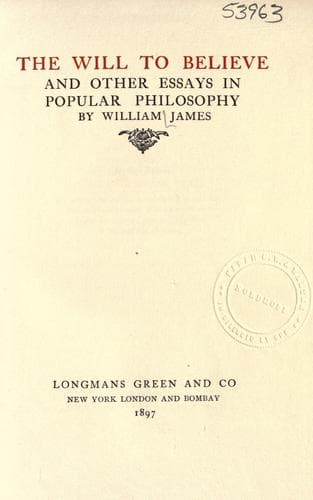
The Will to Believe, and Other Essays in Popular PhilosophyJames, William
Religion
The Will to Believe, and Other Essays in Popular Philosophy
James, William
Belief and doubt; Essays; Philosophy
Well, of course, I agree as far as the facts will allow. Wherever the
option between losing truth and gaining it is not momentous, we can
throw the {20} chance of _gaining truth_ away, and at any rate save
ourselves from any chance of _believing falsehood_, by not making up
our minds at all till objective evidence has come. In scientific
questions, this is almost always the case; and even in human affairs in
general, the need of acting is seldom so urgent that a false belief to
act on is better than no belief at all. Law courts, indeed, have to
decide on the best evidence attainable for the moment, because a
judge's duty is to make law as well as to ascertain it, and (as a
learned judge once said to me) few cases are worth spending much time
over: the great thing is to have them decided on _any_ acceptable
principle, and got out of the way. But in our dealings with objective
nature we obviously are recorders, not makers, of the truth; and
decisions for the mere sake of deciding promptly and getting on to the
next business would be wholly out of place. Throughout the breadth of
physical nature facts are what they are quite independently of us, and
seldom is there any such hurry about them that the risks of being duped
by believing a premature theory need be faced. The questions here are
always trivial options, the hypotheses are hardly living (at any rate
not living for us spectators), the choice between believing truth or
falsehood is seldom forced. The attitude of sceptical balance is
therefore the absolutely wise one if we would escape mistakes. What
difference, indeed, does it make to most of us whether we have or have
not a theory of the Röntgen rays, whether we believe or not in
mind-stuff, or have a conviction about the causality of conscious
states? It makes no difference. Such options are not forced on us.
On every account it is better not to make them, but still keep weighing
reasons _pro et contra_ with an indifferent hand.
{21}
Public-domain text, read in full here on John Shaqi.
Reviews
Reviews
No reviews yet
Be the first to share your thoughts on this work.
Join the Discussion
Join the discussion
Sign in to leave a comment or review.
Sign InorCreate an account