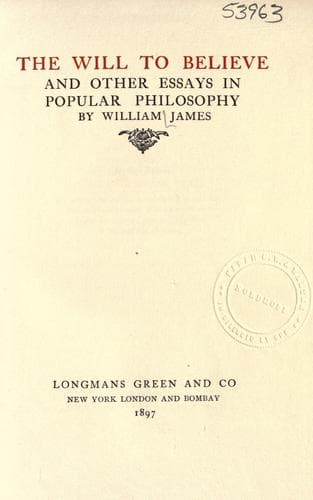
The Will to Believe, and Other Essays in Popular PhilosophyJames, William
Religion
The Will to Believe, and Other Essays in Popular Philosophy
James, William
Belief and doubt; Essays; Philosophy
If moods like this could be made permanent, and constitutions like
these universal, there would never be any occasion for such discourses
as the present one. No philosopher would seek to prove articulately
that life is worth living, for the fact that it absolutely is so would
vouch for itself, and the problem disappear in the vanishing of the
question rather than in the coming of anything like a reply. But we
are not magicians to make the optimistic temperament universal; and
alongside of the deliverances of temperamental optimism concerning
life, those of temperamental pessimism always exist, and oppose to them
a standing refutation. In what is called 'circular insanity,' phases
of melancholy succeed phases of mania, with no outward cause that we
can discover; and often enough to one and the same well person life
will present incarnate radiance to-day and incarnate dreariness
to-morrow, according to the fluctuations of what the older medical
books used to call "the concoction of the humors." In the words of the
newspaper joke, "it depends on the liver." Rousseau's ill-balanced
constitution undergoes a change, and behold him in his latter evil days
a prey to melancholy and black delusions of suspicion and fear. Some
men seem launched upon the world even from their birth with souls as
incapable of happiness as Walt Whitman's was of gloom, and they have
left us their messages in even more lasting verse than his,--the
exquisite Leopardi, for example; or our own contemporary, {35} James
Thomson, in that pathetic book, The City of Dreadful Night, which I
think is less well-known than it should be for its literary beauty,
simply because men are afraid to quote its words,--they are so gloomy,
and at the same time so sincere. In one place the poet describes a
congregation gathered to listen to a preacher in a great unillumined
cathedral at night. The sermon is too long to quote, but it ends
thus:--
"'O Brothers of sad lives! they are so brief;
A few short years must bring us all relief:
Can we not bear these years of laboring breath.
But if you would not this poor life fulfil,
Lo, you are free to end it when you will,
Without the fear of waking after death.'--
"The organ-like vibrations of his voice
Thrilled through the vaulted aisles and died away;
The yearning of the tones which bade rejoice
Was sad and tender as a requiem lay:
Our shadowy congregation rested still,
As brooding on that 'End it when you will.'
* * * * *
"Our shadowy congregation rested still,
As musing on that message we had heard,
And brooding on that 'End it when you will,'
Perchance awaiting yet some other word;
When keen as lightning through a muffled sky
Sprang forth a shrill and lamentable cry;--
"'The man speaks sooth, alas! the man speaks sooth:
We have no personal life beyond the grave;
There is no God; Fate knows nor wrath nor ruth:
Can I find here the comfort which I crave?
Public-domain text, read in full here on John Shaqi.
Reviews
Reviews
No reviews yet
Be the first to share your thoughts on this work.
Join the Discussion
Join the discussion
Sign in to leave a comment or review.
Sign InorCreate an account