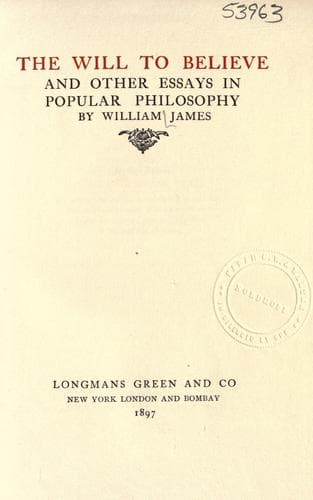
The Will to Believe, and Other Essays in Popular PhilosophyJames, William
Religion
The Will to Believe, and Other Essays in Popular Philosophy
James, William
Belief and doubt; Essays; Philosophy
"'In all eternity I had one chance,
One few years' term of gracious human life,--
The splendors of the intellect's advance,
The sweetness of the home with babes and wife;
{36}
"'The social pleasures with their genial wit;
The fascination of the worlds of art;
The glories of the worlds of Nature lit
By large imagination's glowing heart;
"'The rapture of mere being, full of health;
The careless childhood and the ardent youth;
The strenuous manhood winning various wealth,
The reverend age serene with life's long truth;
"'All the sublime prerogatives of Man;
The storied memories of the times of old,
The patient tracking of the world's great plan
Through sequences and changes myriadfold.
"'This chance was never offered me before;
For me the infinite past is blank and dumb;
This chance recurreth never, nevermore;
Blank, blank for me the infinite To-come.
"'And this sole chance was frustrate from my birth,
A mockery, a delusion; and my breath
Of noble human life upon this earth
So racks me that I sigh for senseless death.
"'My wine of life is poison mixed with gall,
My noonday passes in a nightmare dream,
I worse than lose the years which are my all:
What can console me for the loss supreme?
"'Speak not of comfort where no comfort is,
Speak not at all: can words make foul things fair!
Our life 's a cheat, our death a black abyss:
Hush, and be mute, envisaging despair.'
"This vehement voice came from the northern aisle,
Rapid and shrill to its abrupt harsh close;
And none gave answer for a certain while,
For words must shrink from these most wordless woes;
At last the pulpit speaker simply said,
With humid eyes and thoughtful, drooping head,--
{37}
"'My Brother, my poor Brothers, it is thus:
This life holds nothing good for us,
But it ends soon and nevermore can be;
And we knew nothing of it ere our birth,
And shall know nothing when consigned to earth;
I ponder these thoughts, and they comfort me.'"
"It ends soon, and never more can be," "Lo, you are free to end it when
you will,"--these verses flow truthfully from the melancholy Thomson's
pen, and are in truth a consolation for all to whom, as to him, the
world is far more like a steady den of fear than a continual fountain
of delight. That life is not worth living the whole army of suicides
declare,--an army whose roll-call, like the famous evening gun of the
British army, follows the sun round the world and never terminates.
We, too, as we sit here in our comfort, must 'ponder these things'
also, for we are of one substance with these suicides, and their life
is the life we share. The plainest intellectual integrity,--nay, more,
the simplest manliness and honor, forbid us to forget their case.
Public-domain text, read in full here on John Shaqi.
Reviews
Reviews
No reviews yet
Be the first to share your thoughts on this work.
Join the Discussion
Join the discussion
Sign in to leave a comment or review.
Sign InorCreate an account