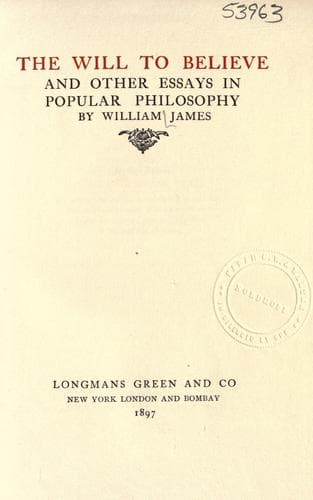
The Will to Believe, and Other Essays in Popular PhilosophyJames, William
Religion
The Will to Believe, and Other Essays in Popular Philosophy
James, William
Belief and doubt; Essays; Philosophy
Now, I do not hesitate frankly and sincerely to confess to you that
this real and genuine discord seems to me to carry with it the
inevitable bankruptcy of natural religion naïvely and simply taken.
There were times when Leibnitzes with their heads buried in monstrous
wigs could compose Theodicies, and when stall-fed officials of an
established church could prove by the valves in the heart and the round
ligament of the hip-joint the existence of a "Moral and Intelligent
Contriver of the World." But those times are past; and we of the
nineteenth century, with our evolutionary theories and our mechanical
philosophies, already know nature too impartially and too well to
worship unreservedly any God of whose character she can be an adequate
expression. Truly, all we know of good and duty proceeds from nature;
but none the less so all we know of evil. Visible nature is all
plasticity and indifference,--a moral multiverse, as one might call it,
and not a moral {44} universe. To such a harlot we owe no allegiance;
with her as a whole we can establish no moral communion; and we are
free in our dealings with her several parts to obey or destroy, and to
follow no law but that of prudence in coming to terms with such other
particular features as will help us to our private ends. If there be a
divine Spirit of the universe, nature, such as we know her, cannot
possibly be its _ultimate word_ to man. Either there is no Spirit
revealed in nature, or else it is inadequately revealed there; and (as
all the higher religions have assumed) what we call visible nature, or
_this_ world, must be but a veil and surface-show whose full meaning
resides in a supplementary unseen or _other_ world.
I cannot help, therefore, accounting it on the whole a gain (though it
may seem for certain poetic constitutions a very sad loss) that the
naturalistic superstition, the worship of the God of nature, simply
taken as such, should have begun to loosen its hold upon the educated
mind. In fact, if I am to express my personal opinion unreservedly, I
should say (in spite of its sounding blasphemous at first to certain
ears) that the initial step towards getting into healthy ultimate
relations with the universe is the act of rebellion against the idea
that such a God exists. Such rebellion essentially is that which in
the chapter I have quoted from Carlyle goes on to describe:--
"'Wherefore, like a coward, dost thou forever pip and whimper, and go
cowering and trembling? Despicable biped!... Hast thou not a heart;
canst thou not suffer whatsoever it be; and, as a Child of Freedom,
though outcast, trample Tophet itself under thy feet, while it consumes
thee? Let it come, then, I will meet it and defy it!' And as I so
thought, there rushed like a stream of fire {45} over my whole soul;
and I shook base Fear away from me forever....
Public-domain text, read in full here on John Shaqi.
Reviews
Reviews
No reviews yet
Be the first to share your thoughts on this work.
Join the Discussion
Join the discussion
Sign in to leave a comment or review.
Sign InorCreate an account