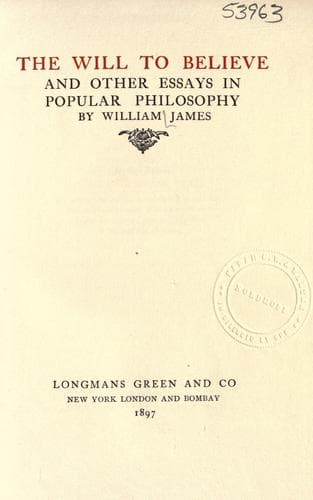
The Will to Believe, and Other Essays in Popular PhilosophyJames, William
Religion
The Will to Believe, and Other Essays in Popular Philosophy
James, William
Belief and doubt; Essays; Philosophy
"Thus had the Everlasting No pealed authoritatively through all the
recesses of my being, of my Me, and then was it that my whole Me stood
up, in native God-created majesty, and recorded its Protest. Such a
Protest, the most important transaction in life, may that same
Indignation and Defiance, in a psychological point of view, be fitly
called. The Everlasting No had said: 'Behold, thou art fatherless,
outcast, and the Universe is mine;' to which my whole Me now made
answer: 'I am not thine, but Free, and forever hate thee!' From that
hour," Teufelsdröckh-Carlyle adds, "I began to be a man."
And our poor friend, James Thomson, similarly writes:--
"Who is most wretched in this dolorous place?
I think myself, yet I would rather be
My miserable self than He, than He
Who formed such creatures to his own disgrace.
The vilest thing must be less vile than Thou
From whom it had its being, God and Lord!
Creator of all woe and sin! abhorred,
Malignant and implacable! I vow
That not for all Thy power furled and unfurled,
For all the temples to Thy glory built,
Would I assume the ignominious guilt
Of having made such men in such a world."
We are familiar enough in this community with the spectacle of persons
exulting in their emancipation from belief in the God of their
ancestral Calvinism,--him who made the garden and the serpent, and
pre-appointed the eternal fires of hell. Some of them have found
humaner gods to worship, others are simply converts from all theology;
but, both alike, they {46} assure us that to have got rid of the
sophistication of thinking they could feel any reverence or duty toward
that impossible idol gave a tremendous happiness to their souls. Now,
to make an idol of the spirit of nature, and worship it, also leads to
sophistication; and in souls that are religious and would also be
scientific the sophistication breeds a philosophical melancholy, from
which the first natural step of escape is the denial of the idol; and
with the downfall of the idol, whatever lack of positive joyousness may
remain, there comes also the downfall of the whimpering and cowering
mood. With evil simply taken as such, men can make short work, for
their relations with it then are only practical. It looms up no longer
so spectrally, it loses all its haunting and perplexing significance,
as soon as the mind attacks the instances of it singly, and ceases to
worry about their derivation from the 'one and only Power.'
Public-domain text, read in full here on John Shaqi.
Reviews
Reviews
No reviews yet
Be the first to share your thoughts on this work.
Join the Discussion
Join the discussion
Sign in to leave a comment or review.
Sign InorCreate an account