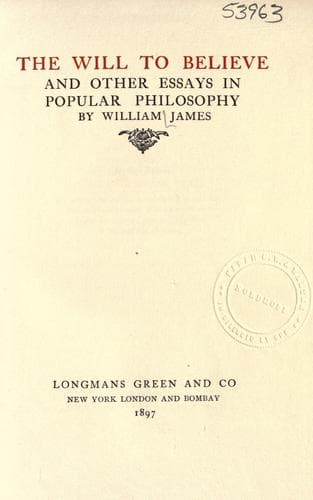
The Will to Believe, and Other Essays in Popular PhilosophyJames, William
Religion
The Will to Believe, and Other Essays in Popular Philosophy
James, William
Belief and doubt; Essays; Philosophy
What are our woes and sufferance compared with these? Does not the
recital of such a fight so obstinately waged against such odds fill us
with resolution against our petty powers of darkness,--machine
politicians, spoilsmen, and the rest? Life is worth living, no matter
what it bring, if only such combats may be carried to successful
terminations and one's heel set on the tyrant's throat. To the
suicide, then, in his supposed world of multifarious and immoral
nature, you can appeal--and appeal in the name of the very evils that
make his heart sick there--to wait and see his part of the battle out.
And the consent to live on, which you ask of him under these {50}
circumstances, is not the sophistical 'resignation' which devotees of
cowering religions preach: it is not resignation in the sense of
licking a despotic Deity's hand. It is, on the contrary, a resignation
based on manliness and pride. So long as your would-be suicide leaves
an evil of his own unremedied, so long he has strictly no concern with
evil in the abstract and at large. The submission which you demand of
yourself to the general fact of evil in the world, your apparent
acquiescence in it, is here nothing but the conviction that evil at
large is _none of your business_ until your business with your private
particular evils is liquidated and settled up. A challenge of this
sort, with proper designation of detail, is one that need only be made
to be accepted by men whose normal instincts are not decayed; and your
reflective would-be suicide may easily be moved by it to face life with
a certain interest again. The sentiment of honor is a very penetrating
thing. When you and I, for instance, realize how many innocent beasts
have had to suffer in cattle-cars and slaughter-pens and lay down their
lives that we might grow up, all fattened and clad, to sit together
here in comfort and carry on this discourse, it does, indeed, put our
relation to the universe in a more solemn light. "Does not," as a
young Amherst philosopher (Xenos Clark, now dead) once wrote, "the
acceptance of a happy life upon such terms involve a point of honor?"
Are we not bound to take some suffering upon ourselves, to do some
self-denying service with our lives, in return for all those lives upon
which ours are built? To hear this question is to answer it in but one
possible way, if one have a normally constituted heart.
{51}
Public-domain text, read in full here on John Shaqi.
Reviews
Reviews
No reviews yet
Be the first to share your thoughts on this work.
Join the Discussion
Join the discussion
Sign in to leave a comment or review.
Sign InorCreate an account