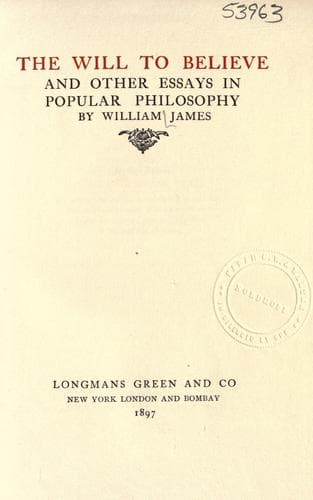
The Will to Believe, and Other Essays in Popular PhilosophyJames, William
Religion
The Will to Believe, and Other Essays in Popular Philosophy
James, William
Belief and doubt; Essays; Philosophy
Thus, then, we see that mere instinctive curiosity, pugnacity, and
honor may make life on a purely naturalistic basis seem worth living
from day to day to men who have cast away all metaphysics in order to
get rid of hypochondria, but who are resolved to owe nothing as yet to
religion and its more positive gifts. A poor half-way stage, some of
you may be inclined to say; but at least you must grant it to be an
honest stage; and no man should dare to speak meanly of these instincts
which are our nature's best equipment, and to which religion herself
must in the last resort address her own peculiar appeals.
IV.
And now, in turning to what religion may have to say to the question, I
come to what is the soul of my discourse. Religion has meant many
things in human history; but when from now onward I use the word I mean
to use it in the supernaturalist sense, as declaring that the so-called
order of nature, which constitutes this world's experience, is only one
portion of the total universe, and that there stretches beyond this
visible world an unseen world of which we now know nothing positive,
but in its relation to which the true significance of our present
mundane life consists. A man's religious faith (whatever more special
items of doctrine it may involve) means for me essentially his faith in
the existence of an unseen order of some kind in which the riddles of
the natural order may be found explained. In the more developed
religions the natural world has always been regarded as the mere
scaffolding or vestibule of a truer, more eternal world, and affirmed
to be a sphere of {52} education, trial, or redemption. In these
religions, one must in some fashion die to the natural life before one
can enter into life eternal. The notion that this physical world of
wind and water, where the sun rises and the moon sets, is absolutely
and ultimately the divinely aimed-at and established thing, is one
which we find only in very early religions, such as that of the most
primitive Jews. It is this natural religion (primitive still, in spite
of the fact that poets and men of science whose good-will exceeds their
perspicacity keep publishing it in new editions tuned to our
contemporary ears) that, as I said a while ago, has suffered definitive
bankruptcy in the opinion of a circle of persons, among whom I must
count myself, and who are growing more numerous every day. For such
persons the physical order of nature, taken simply as science knows it,
cannot be held to reveal any one harmonious spiritual intent. It is
mere _weather_, as Chauncey Wright called it, doing and undoing without
end.
Public-domain text, read in full here on John Shaqi.
Reviews
Reviews
No reviews yet
Be the first to share your thoughts on this work.
Join the Discussion
Join the discussion
Sign in to leave a comment or review.
Sign InorCreate an account