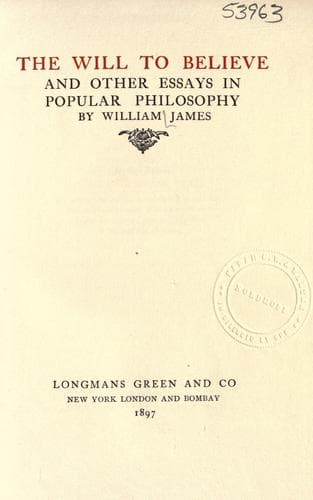
The Will to Believe, and Other Essays in Popular PhilosophyJames, William
Religion
The Will to Believe, and Other Essays in Popular Philosophy
James, William
Belief and doubt; Essays; Philosophy
Now, I wish to make you feel, if I can in the short remainder of this
hour, that we have a right to believe the physical order to be only a
partial order; that we have a right to supplement it by an unseen
spiritual order which we assume on trust, if only thereby life may seem
to us better worth living again. But as such a trust will seem to some
of you sadly mystical and execrably unscientific, I must first say a
word or two to weaken the veto which you may consider that science
opposes to our act.
There is included in human nature an ingrained naturalism and
materialism of mind which can only admit facts that are actually
tangible. Of this sort of mind the entity called 'science' is the
idol. {53} Fondness for the word 'scientist' is one of the notes by
which you may know its votaries; and its short way of killing any
opinion that it disbelieves in is to call it 'unscientific.' It must
be granted that there is no slight excuse for this. Science has made
such glorious leaps in the last three hundred years, and extended our
knowledge of nature so enormously both in general and in detail; men of
science, moreover, have as a class displayed such admirable
virtues,--that it is no wonder if the worshippers of science lose their
head. In this very University, accordingly, I have heard more than one
teacher say that all the fundamental conceptions of truth have already
been found by science, and that the future has only the details of the
picture to fill in. But the slightest reflection on the real
conditions will suffice to show how barbaric such notions are. They
show such a lack of scientific imagination, that it is hard to see how
one who is actively advancing any part of science can make a mistake so
crude. Think how many absolutely new scientific conceptions have
arisen in our own generation, how many new problems have been
formulated that were never thought of before, and then cast an eye upon
the brevity of science's career. It began with Galileo, not three
hundred years ago. Four thinkers since Galileo, each informing his
successor of what discoveries his own lifetime had seen achieved, might
have passed the torch of science into our hands as we sit here in this
room. Indeed, for the matter of that, an audience much smaller than
the present one, an audience of some five or six score people, if each
person in it could speak for his own generation, would carry us away to
the black unknown of the human species, {54} to days without a document
or monument to tell their tale. Is it credible that such a mushroom
knowledge, such a growth overnight as this, _can_ represent more than
the minutest glimpse of what the universe will really prove to be when
adequately understood? No! our science is a drop, our ignorance a sea.
Whatever else be certain, this at least is certain,--that the world of
our present natural knowledge _is_ enveloped in a larger world of
_some_ sort of whose residual properties we at present can frame no
Public-domain text, read in full here on John Shaqi.
Reviews
Reviews
No reviews yet
Be the first to share your thoughts on this work.
Join the Discussion
Join the discussion
Sign in to leave a comment or review.
Sign InorCreate an account