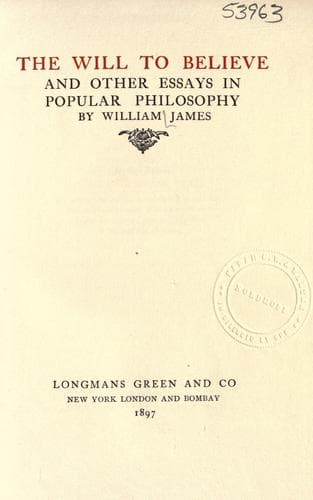
The Will to Believe, and Other Essays in Popular PhilosophyJames, William
Religion
The Will to Believe, and Other Essays in Popular Philosophy
James, William
Belief and doubt; Essays; Philosophy
With regard to all other possible truths, however, a number of our most
influential contemporaries think that an attitude of faith is not only
illogical but shameful. Faith in a religious dogma for which there is
no outward proof, but which we are tempted to postulate for our
emotional interests, just as we {92} postulate the uniformity of nature
for our intellectual interests, is branded by Professor Huxley as "the
lowest depth of immorality." Citations of this kind from leaders of
the modern _Aufklärung_ might be multiplied almost indefinitely. Take
Professor Clifford's article on the 'Ethics of Belief.' He calls it
'guilt' and 'sin' to believe even the truth without 'scientific
evidence.' But what is the use of being a genius, unless _with the
same scientific evidence_ as other men, one can reach more truth than
they? Why does Clifford fearlessly proclaim his belief in the
conscious-automaton theory, although the 'proofs' before him are the
same which make Mr. Lewes reject it? Why does he believe in primordial
units of 'mind-stuff' on evidence which would seem quite worthless to
Professor Bain? Simply because, like every human being of the
slightest mental originality, he is peculiarly sensitive to evidence
that bears in some one direction. It is utterly hopeless to try to
exorcise such sensitiveness by calling it the disturbing subjective
factor, and branding it as the root of all evil. 'Subjective' be it
called! and 'disturbing' to those whom it foils! But if it helps those
who, as Cicero says, "vim naturae magis sentiunt," it is good and not
evil. Pretend what we may, the whole man within us is at work when we
form our philosophical opinions. Intellect, will, taste, and passion
co-operate just as they do in practical affairs; and lucky it is if the
passion be not something as petty as a love of personal conquest over
the philosopher across the way. The absurd abstraction of an intellect
verbally formulating all its evidence and carefully estimating the
probability thereof by a vulgar fraction by the size of whose
denominator and numerator alone it is swayed, is {93} ideally as inept
as it is actually impossible. It is almost incredible that men who are
themselves working philosophers should pretend that any philosophy can
be, or ever has been, constructed without the help of personal
preference, belief, or divination. How have they succeeded in so
stultifying their sense for the living facts of human nature as not to
perceive that every philosopher, or man of science either, whose
initiative counts for anything in the evolution of thought, has taken
his stand on a sort of dumb conviction that the truth must lie in one
direction rather than another, and a sort of preliminary assurance that
his notion can be made to work; and has borne his best fruit in trying
to make it work? These mental instincts in different men are the
spontaneous variations upon which the intellectual struggle for
existence is based.
Public-domain text, read in full here on John Shaqi.
Reviews
Reviews
No reviews yet
Be the first to share your thoughts on this work.
Elsewhere in the archive
Join the Discussion
Join the discussion
Sign in to leave a comment or review.
Sign InorCreate an account