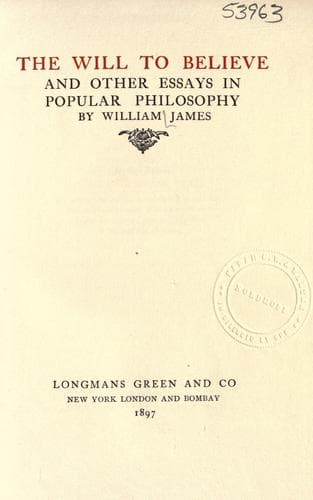
The Will to Believe, and Other Essays in Popular PhilosophyJames, William
Religion
The Will to Believe, and Other Essays in Popular Philosophy
James, William
Belief and doubt; Essays; Philosophy
The fittest conceptions survive, and with them the
names of their champions shining to all futurity.
The coil is about us, struggle as we may. The only escape from faith
is mental nullity. What we enjoy most in a Huxley or a Clifford is not
the professor with his learning, but the human personality ready to go
in for what it feels to be right, in spite of all appearances. The
concrete man has but one interest,--to be right. That for him is the
art of all arts, and all means are fair which help him to it. Naked he
is flung into the world, and between him and nature there are no rules
of civilized warfare. The rules of the scientific game, burdens of
proof, presumptions, _experimenta crucis_, complete inductions, and the
like, are only binding on those who enter that game. As a matter of
fact we all more or less do enter it, because it helps us to our end.
But if the means presume to frustrate the end and call us cheats for
being right in {94} advance of their slow aid, by guesswork or by hook
or crook, what shall we say of them? Were all of Clifford's works,
except the Ethics of Belief, forgotten, he might well figure in future
treatises on psychology in place of the somewhat threadbare instance of
the miser who has been led by the association of ideas to prefer his
gold to all the goods he might buy therewith.
In short, if I am born with such a superior general reaction to
evidence that I can guess right and act accordingly, and gain all that
comes of right action, while my less gifted neighbor (paralyzed by his
scruples and waiting for more evidence which he dares not anticipate,
much as he longs to) still stands shivering on the brink, by what law
shall I be forbidden to reap the advantages of my superior native
sensitiveness? Of course I yield to my belief in such a case as this
or distrust it, alike at my peril, just as I do in any of the great
practical decisions of life. If my inborn faculties are good, I am a
prophet; if poor, I am a failure: nature spews me out of her mouth, and
there is an end of me. In the total game of life we stake our persons
all the while; and if in its theoretic part our persons will help us to
a conclusion, surely we should also stake them there, however
inarticulate they may be.[2]
{95}
Public-domain text, read in full here on John Shaqi.
Reviews
Reviews
No reviews yet
Be the first to share your thoughts on this work.
Elsewhere in the archive
Join the Discussion
Join the discussion
Sign in to leave a comment or review.
Sign InorCreate an account