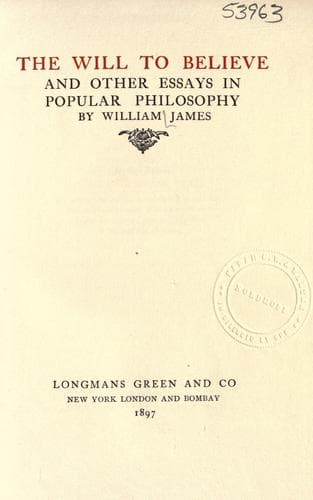
The Will to Believe, and Other Essays in Popular PhilosophyJames, William
Religion
The Will to Believe, and Other Essays in Popular Philosophy
James, William
Belief and doubt; Essays; Philosophy
But in being myself so very articulate in proving what to all readers
with a sense for reality will seem a platitude, am I not wasting words?
We cannot live or think at all without some degree of faith. Faith is
synonymous with working hypothesis. The only difference is that while
some hypotheses can be refuted in five minutes, others may defy ages.
A chemist who conjectures that a certain wall-paper contains arsenic,
and has faith enough to lead him to take the trouble to put some of it
into a hydrogen bottle, finds out by the results of his action whether
he was right or wrong. But theories like that of Darwin, or that of
the kinetic constitution of matter, may exhaust the labors of
generations in their corroboration, each tester of their truth
proceeding in this simple way,--that he acts as if it were true, and
expects the result to disappoint him if his assumption is false. The
longer disappointment is delayed, the stronger grows his faith in his
theory.
Now, in such questions as God, immortality, absolute morality, and
free-will, no non-papal believer at the present day pretends his faith
to be of an essentially different complexion; he can always doubt his
creed. But his intimate persuasion is that the odds in its favor are
strong enough to warrant him in acting all along on the assumption of
its truth. His corroboration or repudiation by the nature of things
may be deferred until the day of judgment. The {96} uttermost he now
means is something like this: "I _expect_ then to triumph with tenfold
glory; but if it should turn out, as indeed it may, that I have spent
my days in a fool's paradise, why, better have been the dupe of _such_
a dreamland than the cunning reader of a world like that which then
beyond all doubt unmasks itself to view." In short, we _go in_ against
materialism very much as we should _go in_, had we a chance, against
the second French empire or the Church of Rome, or any other system of
things toward which our repugnance is vast enough to determine
energetic action, but too vague to issue in distinct argumentation.
Our reasons are ludicrously incommensurate with the volume of our
feeling, yet on the latter we unhesitatingly act.
Now, I wish to show what to my knowledge has never been clearly pointed
out, that belief (as measured by action) not only does and must
continually outstrip scientific evidence, but that there is a certain
class of truths of whose reality belief is a factor as well as a
confessor; and that as regards this class of truths faith is not only
licit and pertinent, but essential and indispensable. The truths
cannot become true till our faith has made them so.
Public-domain text, read in full here on John Shaqi.
Reviews
Reviews
No reviews yet
Be the first to share your thoughts on this work.
Elsewhere in the archive
Join the Discussion
Join the discussion
Sign in to leave a comment or review.
Sign InorCreate an account