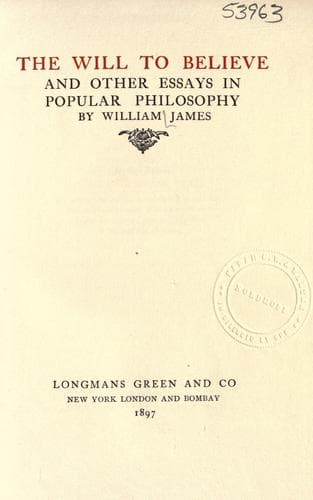
The Will to Believe, and Other Essays in Popular PhilosophyJames, William
Religion
The Will to Believe, and Other Essays in Popular Philosophy
James, William
Belief and doubt; Essays; Philosophy
Suppose, for example, that I am climbing in the Alps, and have had the
ill-luck to work myself into a position from which the only escape is
by a terrible leap. Being without similar experience, I have no
evidence of my ability to perform it successfully; but hope and
confidence in myself make me sure I shall not miss my aim, and nerve my
feet to execute what without those subjective emotions would perhaps
have been impossible. But suppose that, on the contrary, {97} the
emotions of fear and mistrust preponderate; or suppose that, having
just read the Ethics of Belief, I feel it would be sinful to act upon
an assumption unverified by previous experience,--why, then I shall
hesitate so long that at last, exhausted and trembling, and launching
myself in a moment of despair, I miss my foothold and roll into the
abyss. In this case (and it is one of an immense class) the part of
wisdom clearly is to believe what one desires; for the belief is one of
the indispensable preliminary conditions of the realization of its
object. _There are then cases where faith creates its own
verification_. Believe, and you shall be right, for you shall save
yourself; doubt, and you shall again be right, for you shall perish.
The only difference is that to believe is greatly to your advantage.
The future movements of the stars or the facts of past history are
determined now once for all, whether I like them or not. They are
given irrespective of my wishes, and in all that concerns truths like
these subjective preference should have no part; it can only obscure
the judgment. But in every fact into which there enters an element of
personal contribution on my part, as soon as this personal contribution
demands a certain degree of subjective energy which, in its turn, calls
for a certain amount of faith in the result,--so that, after all, the
future fact is conditioned by my present faith in it,--how trebly
asinine would it be for me to deny myself the use of the subjective
method, the method of belief based on desire!
Public-domain text, read in full here on John Shaqi.
Reviews
Reviews
No reviews yet
Be the first to share your thoughts on this work.
Elsewhere in the archive
Join the Discussion
Join the discussion
Sign in to leave a comment or review.
Sign InorCreate an account