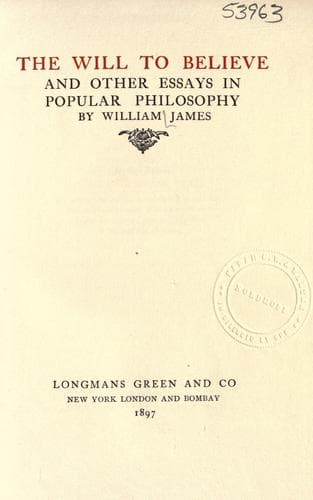
The Will to Believe, and Other Essays in Popular PhilosophyJames, William
Religion
The Will to Believe, and Other Essays in Popular Philosophy
James, William
Belief and doubt; Essays; Philosophy
I have long defended to my own students the lawfulness of voluntarily
adopted faith; but as soon as they have got well imbued with the
logical spirit, they have as a rule refused to admit my contention to
be lawful philosophically, even though in point of fact they were
personally all the time chock-full of some faith or other themselves.
I am all the while, however, so profoundly convinced that my own
position is correct, that your invitation has seemed to me a good
occasion to make my statements more clear. Perhaps your minds will be
more open than those with which I have hitherto had to deal. I will be
as little technical as I can, though I must begin by setting up some
technical distinctions that will help us in the end.
I.
Let us give the name of _hypothesis_ to anything that may be proposed
to our belief; and just as the electricians speak of live and dead
wires, let us speak of any hypothesis as either _live_ or _dead_. A
live hypothesis is one which appeals as a real possibility to him to
whom it is proposed. If I ask you to believe in the Mahdi, the notion
makes no electric connection with your nature,--it refuses to
scintillate with any credibility at all. As an hypothesis it is
completely dead. To an Arab, however (even if he be not one of the
Mahdi's followers), the hypothesis is among the mind's possibilities:
it is alive. This shows that deadness and liveness in an hypothesis
are not intrinsic properties, but relations to the {3} individual
thinker. They are measured by his willingness to act. The maximum of
liveness in an hypothesis means willingness to act irrevocably.
Practically, that means belief; but there is some believing tendency
wherever there is willingness to act at all.
Next, let us call the decision between two hypotheses an _option_.
Options may be of several kinds. They may be--1, _living_ or _dead_;
2, _forced_ or _avoidable_; 3, _momentous_ or _trivial_; and for our
purposes we may call an option a _genuine_ option when it is of the
forced, living, and momentous kind.
1. A living option is one in which both hypotheses are live ones. If
I say to you: "Be a theosophist or be a Mohammedan," it is probably a
dead option, because for you neither hypothesis is likely to be alive.
But if I say: "Be an agnostic or be a Christian," it is otherwise:
trained as you are, each hypothesis makes some appeal, however small,
to your belief.
Public-domain text, read in full here on John Shaqi.
Reviews
Reviews
No reviews yet
Be the first to share your thoughts on this work.
Join the Discussion
Join the discussion
Sign in to leave a comment or review.
Sign InorCreate an account