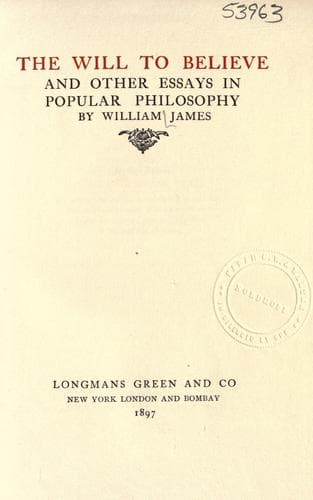
The Will to Believe, and Other Essays in Popular PhilosophyJames, William
Religion
The Will to Believe, and Other Essays in Popular Philosophy
James, William
Belief and doubt; Essays; Philosophy
2. Next, if I say to you: "Choose between going out with your umbrella
or without it," I do not offer you a genuine option, for it is not
forced. You can easily avoid it by not going out at all. Similarly,
if I say, "Either love me or hate me," "Either call my theory true or
call it false," your option is avoidable. You may remain indifferent
to me, neither loving nor hating, and you may decline to offer any
judgment as to my theory. But if I say, "Either accept this truth or
go without it," I put on you a forced option, for there is no standing
place outside of the alternative. Every dilemma based on a complete
logical disjunction, with no possibility of not choosing, is an option
of this forced kind.
{4}
3. Finally, if I were Dr. Nansen and proposed to you to join my North
Pole expedition, your option would be momentous; for this would
probably be your only similar opportunity, and your choice now would
either exclude you from the North Pole sort of immortality altogether
or put at least the chance of it into your hands. He who refuses to
embrace a unique opportunity loses the prize as surely as if he tried
and failed. _Per contra_, the option is trivial when the opportunity
is not unique, when the stake is insignificant, or when the decision is
reversible if it later prove unwise. Such trivial options abound in
the scientific life. A chemist finds an hypothesis live enough to
spend a year in its verification: he believes in it to that extent.
But if his experiments prove inconclusive either way, he is quit for
his loss of time, no vital harm being done.
It will facilitate our discussion if we keep all these distinctions
well in mind.
II.
The next matter to consider is the actual psychology of human opinion.
When we look at certain facts, it seems as if our passional and
volitional nature lay at the root of all our convictions. When we look
at others, it seems as if they could do nothing when the intellect had
once said its say. Let us take the latter facts up first.
Public-domain text, read in full here on John Shaqi.
Reviews
Reviews
No reviews yet
Be the first to share your thoughts on this work.
Join the Discussion
Join the discussion
Sign in to leave a comment or review.
Sign InorCreate an account