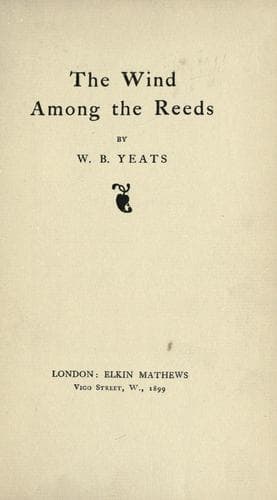
The Wind Among the ReedsYeats, W. B. (William Butler)
General
The Wind Among the Reeds
Yeats, W. B. (William Butler)
English poetry -- Irish authors
The Rose has been for many centuries a symbol of spiritual love and
supreme beauty. The Count Goblet D'Alviella thinks that it was once a
symbol of the sun,--itself a principal symbol of the divine nature, and
the symbolic heart of things. The lotus was in some Eastern countries
imagined blossoming upon the Tree of Life, as the Flower of Life, and is
thus represented in Assyrian bas-reliefs. Because the Rose, the flower
sacred to the Virgin Mary, and the flower that Apuleius' adventurer ate,
when he was changed out of the ass's shape and received into the
fellowship of Isis, is the western Flower of Life, I have imagined it
growing upon the Tree of Life. I once stood beside a man in Ireland when
he saw it growing there in a vision, that seemed to have rapt him out of
his body. He saw the garden of Eden walled about, and on the top of a
high mountain, as in certain mediæval diagrams, and after passing the
Tree of Knowledge, on which grew fruit full of troubled faces, and
through whose branches flowed, he was told, sap that was human souls, he
came to a tall, dark tree, with little bitter fruits, and was shown a
kind of stair or ladder going up through the tree, and told to go up;
and near the top of the tree, a beautiful woman, like the Goddess of
Life associated with the tree in Assyria, gave him a rose that seemed
to have been growing upon the tree. One finds the Rose in the Irish
poets, sometimes as a religious symbol, as in the phrase, 'the Rose of
Friday,' meaning the Rose of austerity, in a Gaelic poem in Dr. Hyde's
'Religious Songs of Connacht;' and, I think, as a symbol of woman's
beauty in the Gaelic song, 'Roseen Dubh;' and a symbol of Ireland in
Mangan's adaptation of 'Roseen Dubh,' 'My Dark Rosaleen,' and in Mr.
Aubrey de Vere's 'The Little Black Rose.' I do not know any evidence to
prove whether this symbol came to Ireland with mediæval Christianity, or
whether it has come down from Celtic times. I have read somewhere that a
stone engraved with a Celtic god, who holds what looks like a rose in
one hand, has been found somewhere in England; but I cannot find the
reference, though I certainly made a note of it. If the Rose was really
a symbol of Ireland among the Gaelic poets, and if 'Roseen Dubh' is
really a political poem, as some think, one may feel pretty certain that
the ancient Celts associated the Rose with Eire, or Fotla, or
Banba--goddesses who gave their names to Ireland--or with some principal
god or goddess, for such symbols are not suddenly adopted or invented,
but come out of mythology.
Public-domain text, read in full here on John Shaqi.
Reviews
Reviews
No reviews yet
Be the first to share your thoughts on this work.
Join the Discussion
Join the discussion
Sign in to leave a comment or review.
Sign InorCreate an account