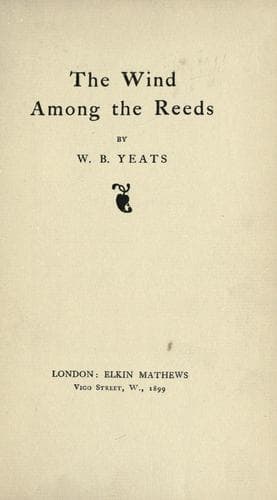
The Wind Among the ReedsYeats, W. B. (William Butler)
General
The Wind Among the Reeds
Yeats, W. B. (William Butler)
English poetry -- Irish authors
The poem was suggested to me by a Greek folk song; but the folk belief
of Greece is very like that of Ireland, and I certainly thought, when I
wrote it, of Ireland, and of the spirits that are in Ireland. An old man
who was cutting a quickset hedge near Gort, in Galway, said, only the
other day, 'One time I was cutting timber over in Inchy, and about eight
o'clock one morning, when I got there, I saw a girl picking nuts, with
her hair hanging down over her shoulders; brown hair; and she had a
good, clean face, and she was tall, and nothing on her head, and her
dress no way gaudy, but simple. And when she felt me coming she gathered
herself up, and was gone, as if the earth had swallowed her up. And I
followed her, and looked for her, but I never could see her again from
that day to this, never again.'
The county Galway people use the word 'clean' in its old sense of fresh
and comely.
MICHAEL ROBARTES BIDS HIS BELOVED BE AT PEACE.
November, the old beginning of winter, or of the victory of the Fomor,
or powers of death, and dismay, and cold, and darkness, is associated by
the Irish people with the horse-shaped Púcas, who are now mischievous
spirits, but were once Fomorian divinities. I think that they may have
some connection with the horses of Mannannan, who reigned over the
country of the dead, where the Fomorian Tethra reigned also; and the
horses of Mannannan, though they could cross the land as easily as the
sea, are constantly associated with the waves. Some neo-platonist, I
forget who, describes the sea as a symbol of the drifting indefinite
bitterness of life, and I believe there is like symbolism intended in
the many Irish voyages to the islands of enchantment, or that there was,
at any rate, in the mythology out of which these stories have been
shaped. I follow much Irish and other mythology, and the magical
tradition, in associating the North with night and sleep, and the East,
the place of sunrise, with hope, and the South, the place of the sun
when at its height, with passion and desire, and the West, the place of
sunset, with fading and dreaming things.
MONGAN LAMENTS THE CHANGE THAT HAS COME UPON HIM AND HIS BELOVED.
HANRAHAN LAMENTS BECAUSE OF HIS WANDERINGS.
Public-domain text, read in full here on John Shaqi.
Reviews
Reviews
No reviews yet
Be the first to share your thoughts on this work.
Join the Discussion
Join the discussion
Sign in to leave a comment or review.
Sign InorCreate an account