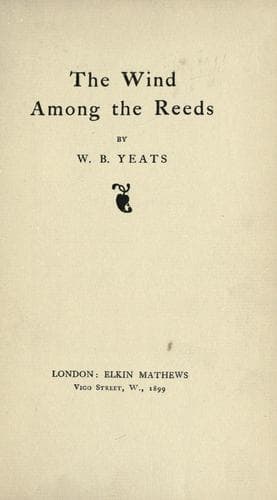
The Wind Among the ReedsYeats, W. B. (William Butler)
General
The Wind Among the Reeds
Yeats, W. B. (William Butler)
English poetry -- Irish authors
My deer and hound are properly related to the deer and hound that
flicker in and out of the various tellings of the Arthurian legends,
leading different knights upon adventures, and to the hounds and to the
hornless deer at the beginning of, I think, all tellings of Oisin's
journey to the country of the young. The hound is certainly related to
the Hounds of Annwvyn or of Hades, who are white, and have red ears, and
were heard, and are, perhaps, still heard by Welsh peasants following
some flying thing in the night winds; and is probably related to the
hounds that Irish country people believe will awake and seize the souls
of the dead if you lament them too loudly or too soon, and to the hound
the son of Setanta killed, on what was certainly, in the first form of
the tale, a visit to the Celtic Hades. An old woman told a friend and
myself that she saw what she thought were white birds, flying over an
enchanted place, but found, when she got near, that they had dog's
heads; and I do not doubt that my hound and these dog-headed birds are
of the same family. I got my hound and deer out of a last century Gaelic
poem about Oisin's journey to the country of the young. After the
hunting of the hornless deer, that leads him to the seashore, and while
he is riding over the sea with Niam, he sees amid the waters--I have not
the Gaelic poem by me, and describe it from memory--a young man
following a girl who has a golden apple, and afterwards a hound with one
red ear following a deer with no horns. This hound and this deer seem
plain images of the desire of man 'which is for the woman,' and 'the
desire of the woman which is for the desire of the man,' and of all
desires that are as these. I have read them in this way in 'The
Wanderings of Usheen' or Oisin, and have made my lover sigh because he
has seen in their faces 'the immortal desire of immortals.' A solar
mythologist would perhaps say that the girl with the golden apple was
once the winter, or night, carrying the sun away, and the deer without
horns, like the boar without bristles, darkness flying the light. He
would certainly, I think, say that when Cuchullain, whom Professor Rhys
calls a solar hero, hunted the enchanted deer of Slieve Fuadh, because
the battle fury was still on him, he was the sun pursuing clouds, or
cold, or darkness. I have understood them in this sense in 'Hanrahan
laments because of his wandering,' and made Hanrahan long for the day
when they, fragments of ancestral darkness, will overthrow the world.
The desire of the woman, the flying darkness, it is all one! The
image--a cross, a man preaching in the wilderness, a dancing Salome, a
lily in a girl's hand, a flame leaping, a globe with wings, a pale
sunset over still waters--is an eternal act; but our understandings are
temporal and understand but a little at a time.
Public-domain text, read in full here on John Shaqi.
Reviews
Reviews
No reviews yet
Be the first to share your thoughts on this work.
Join the Discussion
Join the discussion
Sign in to leave a comment or review.
Sign InorCreate an account