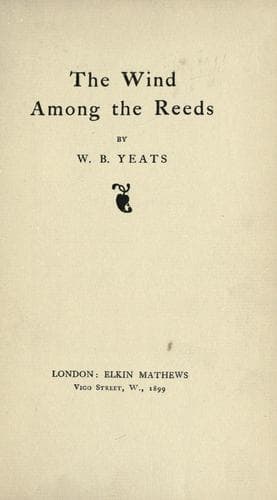
The Wind Among the ReedsYeats, W. B. (William Butler)
General
The Wind Among the Reeds
Yeats, W. B. (William Butler)
English poetry -- Irish authors
The country people say there is
no shape for a spirit to take so dangerous as the shape of a pig; and a
Galway blacksmith--and blacksmiths are thought to be especially
protected--says he would be afraid to meet a pig on the road at night;
and another Galway man tells this story: 'There was a man coming the
road from Gort to Garryland one night, and he had a drop taken; and
before him, on the road, he saw a pig walking; and having a drop in, he
gave a shout, and made a kick at it, and bid it get out of that. And by
the time he got home, his arm was swelled from the shoulder to be as big
as a bag, and he couldn't use his hand with the pain of it. And his wife
brought him, after a few days, to a woman that used to do cures at
Rahasane. And on the road all she could do would hardly keep him from
lying down to sleep on the grass. And when they got to the woman she
knew all that happened; and, says she, it's well for you that your wife
didn't let you fall asleep on the grass, for if you had done that but
even for one instant, you'd be a lost man.'
It is possible that bristles were associated with fertility, as the tail
certainly was, for a pig's tail is stuck into the ground in Courland,
that the corn may grow abundantly, and the tails of pigs, and other
animal embodiments of the corn genius, are dragged over the ground to
make it fertile in different countries. Professor Rhys, who considers
the bristleless boar a symbol of darkness and cold, rather than of
winter and cold, thinks it was without bristles because the darkness is
shorn away by the sun. It may have had different meanings, just as the
scourging of the man-god has had different though not contradictory
meanings in different epochs of the world.
The Battle should, I believe, be compared with three other battles; a
battle the Sidhe are said to fight when a person is being taken away by
them; a battle they are said to fight in November for the harvest; the
great battle the Tribes of the goddess Danu fought, according to the
Gaelic chroniclers, with the Fomor at Moy Tura, or the Towery Plain.
Public-domain text, read in full here on John Shaqi.
Reviews
Reviews
No reviews yet
Be the first to share your thoughts on this work.
Join the Discussion
Join the discussion
Sign in to leave a comment or review.
Sign InorCreate an account