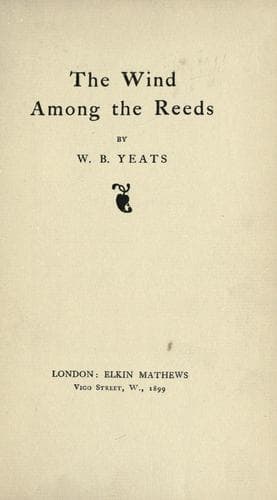
The Wind Among the ReedsYeats, W. B. (William Butler)
General
The Wind Among the Reeds
Yeats, W. B. (William Butler)
English poetry -- Irish authors
The man in my poem who has a hazel wand may have been Aengus, Master of
Love; and I have made the boar without bristles come out of the West,
because the place of sunset was in Ireland, as in other countries, a
place of symbolic darkness and death.
THE CAP AND BELLS.
I dreamed this story exactly as I have written it, and dreamed another
long dream after it, trying to make out its meaning, and whether I was
to write it in prose or verse. The first dream was more a vision than a
dream, for it was beautiful and coherent, and gave me the sense of
illumination and exaltation that one gets from visions, while the second
dream was confused and meaningless. The poem has always meant a great
deal to me, though, as is the way with symbolic poems, it has not always
meant quite the same thing. Blake would have said 'the authors are in
eternity,' and I am quite sure they can only be questioned in dreams.
THE VALLEY OF THE BLACK PIG.
All over Ireland there are prophecies of the coming rout of the enemies
of Ireland, in a certain Valley of the Black Pig, and these prophecies
are, no doubt, now, as they were in the Fenian days, a political force.
I have heard of one man who would not give any money to the Land League,
because the Battle could not be until the close of the century; but, as
a rule, periods of trouble bring prophecies of its near coming. A few
years before my time, an old man who lived at Lisadell, in Sligo, used
to fall down in a fit and rave out descriptions of the Battle; and a man
in Sligo has told me that it will be so great a battle that the horses
shall go up to their fetlocks in blood, and that their girths, when it
is over, will rot from their bellies for lack of a hand to unbuckle
them. The battle is a mythological battle, and the black pig is one with
the bristleless boar, that killed Dearmod, in November, upon the western
end of Ben Bulben; Misroide MacDatha's sow, whose carving brought on so
great a battle; 'the croppy black sow,' and 'the cutty black sow' of
Welsh November rhymes ('Celtic Heathendom,' pages 509-516); the boar
that killed Adonis; the boar that killed Attis; and the pig embodiment
of Typhon ('Golden Bough,' II. pages 26, 31). The pig seems to have been
originally a genius of the corn, and, seemingly because the too great
power of their divinity makes divine things dangerous to mortals, its
flesh was forbidden to many eastern nations; but as the meaning of the
prohibition was forgotten, abhorrence took the place of reverence, pigs
and boars grew into types of evil, and were described as the enemies of
the very gods they once typified ('Golden Bough,' II. 26-31, 56-57). The
Pig would, therefore, become the Black Pig, a type of cold and of winter
that awake in November, the old beginning of winter, to do battle with
the summer, and with the fruit and leaves, and finally, as I suggest;
and as I believe, for the purposes of poetry; of the darkness that will
at last destroy the gods and the world.
Public-domain text, read in full here on John Shaqi.
Reviews
Reviews
No reviews yet
Be the first to share your thoughts on this work.
Join the Discussion
Join the discussion
Sign in to leave a comment or review.
Sign InorCreate an account