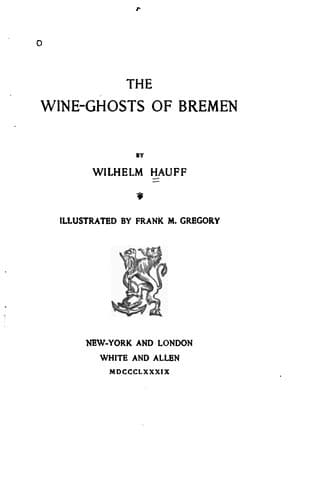
Wilhelm Hauff was born on the 29th November, 1802, at Stuttgart, where
his father held various high posts, with various high-sounding double
and treble official names, under the paternal government of the Elector
Frederick, the first of his name and house who attained 'serenity.' It
was this same ruler who three years later, after refusing a passage to
Napoleon's troops for some time with great show of patriotism, allowed
himself to be 'convinced,' as soon as the Emperor himself appeared and
offered him a considerable extension of territory and a Royal Crown;
and who confessed with some _naïveté_ 'that since Frederick the Great
he had never met any one so good at talking a man over as Napoleon;
that the latter had in fact the same "tournure de l'esprit" as
Frederick.' But His Serene Highness was, in common with many of his
contemporaries, in the habit of allowing himself to be talked over by
any one with a good strong army at his back. 'C'était leur nature de
complaire aux plus forts.' Therefore he now openly joined, in 1805, as
he had practically done in '95 and '99, the row of princely traitors to
the cause of Germany, and began to dance with his fellows on the
fast-closing grave of the Holy Roman Empire. It must however be
remembered that his country was one of the few German principalities
that still possessed an active 'Landstände' or system of Estates: this
was indeed of the most rudimentary order, and consisted chiefly of
representatives of the nobles, craft gilds, and ecclesiastical
corporations; but it is worthy of note that, as in the Tyrol, there was
a Peasants' Estate in Württemberg, and that these Estates did possess,
though they rarely made good, the right of voting or withholding
supplies from His Serenity. On the occasion referred to, when he
expressed some doubts as to whether his Estates would agree to the
proposed treaty, Napoleon, who had methods of his own for dealing with
refractory representatives, answered that 'he would settle all that.'
The Elector then got his crown from Napoleon; but in November, 1813, a
very similar scene was enacted at Stuttgart, (with Alexander in place
of Napoleon,) when the confederation of the Rhine was dissolved, and
Bavaria had already made her peace with the allies by the treaty of
Ried. Then the magnanimous King Frederick threw in his lot with the
winning side again, in return for that fatal guarantee of absolute
sovereignty and territorial indemnification for his losses, (for he was
obliged to disgorge some of the spoils of his neighbours,) which proved
such an obstacle in the way of the long-deferred restoration of
Germany.
Public-domain text, read in full here on John Shaqi.
Reviews
Reviews
No reviews yet
Be the first to share your thoughts on this work.
Join the Discussion
Join the discussion
Sign in to leave a comment or review.
Sign InorCreate an account