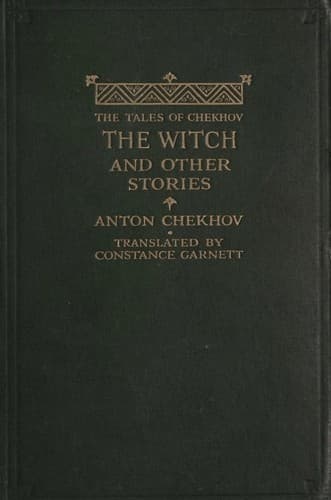
The Witch, and Other StoriesChekhov, Anton Pavlovich
General
The Witch, and Other Stories
Chekhov, Anton Pavlovich
Chekhov, Anton Pavlovich, 1860-1904 -- Translations into English; Russia -- Social life and customs -- Fiction; Short stories
“Things were better in the old days under the gentry,” said the old
father as he wound silk. “You worked and ate and slept, everything in
its turn. At dinner you had cabbage-soup and boiled grain, and at supper
the same again. Cucumbers and cabbage in plenty: you could eat to your
heart’s content, as much as you wanted. And there was more strictness.
Everyone minded what he was about.”
The hut was lighted by a single little lamp, which burned dimly and
smoked. When someone screened the lamp and a big shadow fell across the
window, the bright moonlight could be seen. Old Osip, speaking slowly,
told them how they used to live before the emancipation; how in those
very parts, where life was now so poor and so dreary, they used to
hunt with harriers, greyhounds, retrievers, and when they went out as
beaters the peasants were given vodka; how whole waggonloads of game
used to be sent to Moscow for the young masters; how the bad were beaten
with rods or sent away to the Tver estate, while the good were rewarded.
And Granny told them something, too. She remembered everything,
positively everything. She described her mistress, a kind, God-fearing
woman, whose husband was a profligate and a rake, and all of whose
daughters made unlucky marriages: one married a drunkard, another
married a workman, the other eloped secretly (Granny herself, at that
time a young girl, helped in the elopement), and they had all three as
well as their mother died early from grief. And remembering all this,
Granny positively began to shed tears.
All at once someone knocked at the door, and they all started.
“Uncle Osip, give me a night’s lodging.”
The little bald old man, General Zhukov’s cook, the one whose cap had
been burnt, walked in. He sat down and listened, then he, too, began
telling stories of all sorts. Nikolay, sitting on the stove with his
legs hanging down, listened and asked questions about the dishes that
were prepared in the old days for the gentry. They talked of rissoles,
cutlets, various soups and sauces, and the cook, who remembered
everything very well, mentioned dishes that are no longer served. There
was one, for instance--a dish made of bulls’ eyes, which was called
“waking up in the morning.”
“And used you to do cutlets a la marechal?” asked Nikolay.
“No.”
Nikolay shook his head reproachfully and said:
“Tut, tut! You were not much of a cook!”
The little girls sitting and lying on the stove stared down without
blinking; it seemed as though there were a great many of them, like
cherubim in the clouds. They liked the stories: they were breathless;
they shuddered and turned pale with alternate rapture and terror, and
they listened breathlessly, afraid to stir, to Granny, whose stories
were the most interesting of all.
Public-domain text, read in full here on John Shaqi.
Reviews
Reviews
No reviews yet
Be the first to share your thoughts on this work.
Elsewhere in the archive
Join the Discussion
Join the discussion
Sign in to leave a comment or review.
Sign InorCreate an account