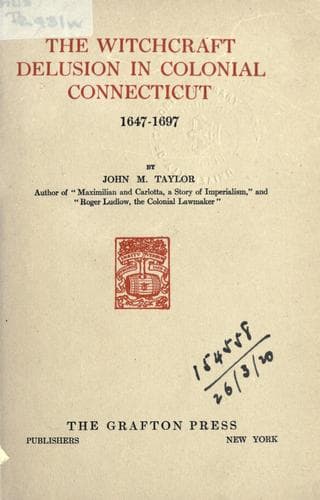
The Witchcraft Delusion in Colonial Connecticut (1647-1697)Taylor, John M. (John Metcalf)
History
The Witchcraft Delusion in Colonial Connecticut (1647-1697)
Taylor, John M. (John Metcalf)
Connecticut -- History -- Colonial period, ca. 1600-1775; Witchcraft -- Connecticut -- History
"And so, from court to court throughout the towns and villages of all
the diocese, scurried special accusers, inquisitors, notaries, jurors,
judges, constables, dragging to trial and torture human beings of both
sexes and burning them in great numbers. Scarcely any of those who were
accused escaped punishment. Nor were there spared even the leading men
in the city of Trier. For the Judge, with two Burgomasters, several
Councilors and Associate Judges, canons of sundry collegiate churches,
parish-priests, rural deans, were swept away in this ruin. So far, at
length, did the madness of the furious populace and of the courts go in
this thirst for blood and booty that there was scarcely anybody who was
not smirched by some suspicion of this crime.
"Meanwhile notaries, copyists, and innkeepers grew rich. The executioner
rode a blooded horse, like a noble of the court, and went clad in gold
and silver; his wife vied with noble dames in the richness of her array.
The children of those convicted and punished were sent into exile; their
goods were confiscated; plowman and vintner failed." (_The Witch
Persecutions_, pp. 13-14, BURR.)
Fanaticism did not rule and ruin without hindrance and remonstrance. Men
of great learning and exalted position struck mighty blows at the root
of the evil. They could not turn the tide but they stemmed it, and their
attacks upon the whole theory of Satanic power and the methods of
persecution were potent in the reaction to humanity and a reign of
reason.
Always to be remembered among these men of power are Johann Wier,
Friedrich Spee, and notably Reginald Scot, who in his _Discovery of
Witchcraft_, in 1584, undertook to prove that "the contracts and
compacts of witches with devils and all infernal spirits and familiars,
are but erroneous novelties and erroneous conceptions."
"After all it is setting a high value on our conjectures to roast a man
alive on account of them." (MONTAIGNE.)
Who may measure in romance and the drama the presence, the cogent and
undeniable power of those same abiding elements of mysticism and
mystery, which underlie all human experience, and repeated in myriad
forms find their classic expression in the queries of the "Weird
Sisters," "_those elemental avengers without sex or kin_"?
"When shall we three meet again,
In thunder, lightning or in rain?
When the hurly burly's done,
When the battle's lost and won."
Are not the mummeries of the witches about the cauldron in Macbeth, and
Talbot's threat pour la Pucelle,
"Blood will I draw on thee, thou art a witch,"
uttered so long ago, echoed in the wailing cry of La Meffraye in the
forests of Machecoul, in the maledictions of Grio, and of the Saga of
the Burning Fields?
Public-domain text, read in full here on John Shaqi.
Reviews
Reviews
No reviews yet
Be the first to share your thoughts on this work.
Join the Discussion
Join the discussion
Sign in to leave a comment or review.
Sign InorCreate an account