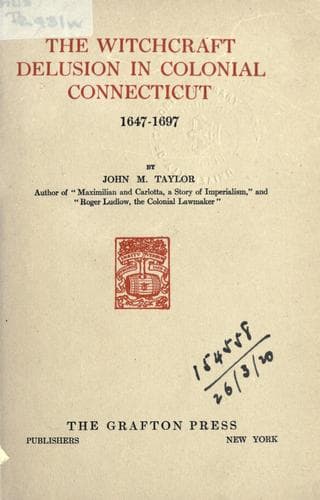
The Witchcraft Delusion in Colonial Connecticut (1647-1697)Taylor, John M. (John Metcalf)
History
The Witchcraft Delusion in Colonial Connecticut (1647-1697)
Taylor, John M. (John Metcalf)
Connecticut -- History -- Colonial period, ca. 1600-1775; Witchcraft -- Connecticut -- History
Their vitality is also clearly shown in their constant use and
exemplification by the romance and novel writers who appeal with
certainty and success to the popular taste in the tales of spectral
terrors. Witness: Farjeon's _The Turn of the Screw_; Bierce's _The
Damned Thing_; Bulwer's _A Strange Story_; Cranford's _Witch of Prague_;
Howells' _The Shadow of a Dream_; Winthrop's _Cecil Dreeme_; Grusot's
_Night Side of Nature_; Crockett's Black Douglas; and _The Red Axe_,
Francis' _Lychgate Hall_; Caine's _The Shadow of a Crime_; and countless
other stories, traditions, tales, and legends, written and unwritten,
that invite and receive a gracious hospitality on every hand.
CHAPTER III
"A belief in witchcraft had always existed; it was entertained by Coke,
Bacon, Hale and even Blackstone. It was a misdemeanor at English common
law and made a felony without benefit of clergy by 33 Henry VIII, c. 8,
and 5 Eliz., c. 16, and the more severe statute of I Jas. 1, ch. 12."
_Connecticut--Origin of her Courts and Laws_ (N.E. States, Vol I,
p. 487-488), HAMERSLEY.
"Selden took up a somewhat peculiar and characteristic position. He
maintained that the law condemning women to death for witchcraft was
perfectly just, but that it was quite unnecessary to ascertain whether
witchcraft was a possibility. A woman might not be able to destroy the
life of her neighbor by her incantations; but if she intended to do so,
it was right that she should be hung." _Rationalism in Europe_ (Vol. 1,
p. 123) LECKY.
The fundamental authority for legislation, for the decrees of courts and
councils as to witchcraft, from the days of the Witch of Endor to those
of Mercy Disborough of Fairfield, and Giles Corey of Salem Farms, was
the code of the Hebrews and its recognition in the Gospel dispensations.
Thereon rest most of the historic precedents, legislative,
ecclesiastical, and judicial.
"Thou shalt not suffer a witch to live." Exodus xxii, 18.
What law embalmed in ancientry and honored as of divine origin has been
more fruitful of sacrifice and suffering? Through the Scriptures,
gathering potency as it goes, runs the same grim decree, with widening
definitions.
"And the soul that turneth after such as have familiar spirits and
after wizards ... I will even set my face against that soul and will cut
him off from among his people." Deuteronomy xviii, 10-11.
"There shall not be found among you any one that maketh his son or his
daughter to pass through the fire, or that useth divination, or an
observer of times, or an enchanter, or a consulter with familiar
spirits, or a wizard, or a necromancer." Deuteronomy xviii, 10-11.
"Saul had put away those that had familiar spirits, and the wizards out
of the land." Samuel i, 3.
Public-domain text, read in full here on John Shaqi.
Reviews
Reviews
No reviews yet
Be the first to share your thoughts on this work.
Join the Discussion
Join the discussion
Sign in to leave a comment or review.
Sign InorCreate an account