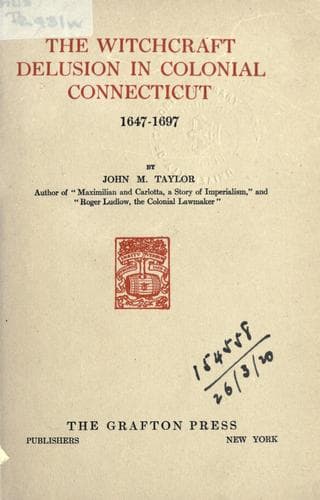
The Witchcraft Delusion in Colonial Connecticut (1647-1697)Taylor, John M. (John Metcalf)
History
The Witchcraft Delusion in Colonial Connecticut (1647-1697)
Taylor, John M. (John Metcalf)
Connecticut -- History -- Colonial period, ca. 1600-1775; Witchcraft -- Connecticut -- History
"Now Saul the king of the Hebrews, had cast out of the country the
fortune tellers, and the necromancers, and all such as exercised the
like arts, excepting the prophets.... Yet did he bid his servants to
inquire out for him some woman that was a necromancer, and called up the
souls of the dead, that so he might know whether his affairs would
succeed to his mind; for this sort of necromantic women that bring up
the souls of the dead, do by them foretell future events." Josephus,
Book 6, ch. 14.
"For rebellion is as the sin of witchcraft." Samuel i, 15-23.
"And I will cut off witchcraft out of the land." Micah v. 12.
"Many of them also which used curious arts brought their books together
and burned them." Acts xix, 19.
"But there was a certain man called Simon which beforetime in the same
city used sorcery and bewitched the people of Samaria." Acts viii, 9.
"If a man abide not in me, he is cast forth as a branch, and is
withered, and men gather them and cast them into the fire, and they are
burned."[C] John xv, 6.
[Footnote C: In the opinion of the eminent Italian jurist Bartolo,
witches were burned alive in early times on this authority.]
These citations make clear the scriptural recognition of witchcraft as a
heinous sin and crime. It is, however, necessary to draw a broad line of
demarcation between the ancient forms and manifestations which have been
brought into view for an illustrative purpose, and that delusion or
mania which centered in the theologic belief and teaching that Satan was
the arch enemy of mankind, and clothed with such power over the souls of
men as to make compacts with them, and to hold supremacy over them in
the warfare between good and evil.
The church from its earliest history looked upon witchcraft as a deadly
sin, and disbelief in it as a heresy, and set its machinery in motion
for its extirpation. Its authority was the word of God and the civil
law, and it claimed jurisdiction through the ecclesiastical courts, the
secular courts, however, acting as the executive of their decrees and
sentences.
Such was the cardinal principle which governed in the merciless attempts
to suppress the epidemic in spreading from the continent to England and
Scotland, and at last to the Puritan colonies in America, where the last
chapter of its history was written.
There can be no better, no more comprehensive modern definition of the
crime once a heresy, or of the popular conception of it, than the one
set forth in the New England indictments, to wit: "interteining
familiarity with Satan the enemy of mankind, and by his help doing
works above the course of nature."
In few words Henry Charles Lea, in his _History of the Inquisition in
the Middle Ages_, analyzes the development of the Satanic doctrine from
a superstition into its acceptance as a dogma of Christian belief.
Public-domain text, read in full here on John Shaqi.
Reviews
Reviews
No reviews yet
Be the first to share your thoughts on this work.
Join the Discussion
Join the discussion
Sign in to leave a comment or review.
Sign InorCreate an account