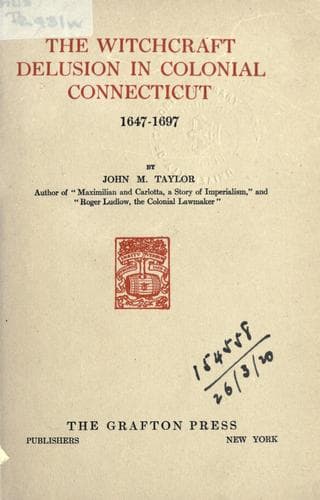
The Witchcraft Delusion in Colonial Connecticut (1647-1697)Taylor, John M. (John Metcalf)
History
The Witchcraft Delusion in Colonial Connecticut (1647-1697)
Taylor, John M. (John Metcalf)
Connecticut -- History -- Colonial period, ca. 1600-1775; Witchcraft -- Connecticut -- History
The flames burning so long and so fiercely on the continent at first
spread slowly in England and Scotland. Sorcery in some of its guises had
obtained therein ever since the Conquest, and victims had been burned
under the king's writ after sentence in the ecclesiastical courts; but
witchcraft as a compact with Satan was not made a felony until 1541, by
a statute of Henry VIII. Cranmer, in his _Articles of Visitation_ in
1549, enjoined the clergy to inquire as to any craft invented by the
Devil; and Bishop Jewell, preaching before the queen in 1558, said:
"It may please your Grace to understand that witches and sorcerers
within these last few years are marvelously increased within your
Grace's realm, Your Grace's subjects pine away even unto the death,
their colour fadeth, their flesh rotteth, their speech is benumbed,
their senses are bereft."
The act of 1541 was amended in Queen Elizabeth's reign, in 1562, but at
the accession of James I--himself a fanatic and bigot in religious
matters, and the author of the famous _Dæmonologie_--a new law was
enacted with exact definition of the crime, which remained in force more
than a hundred years. Its chief provision was this:
"If any person or persons use, practice or exercise any invocation or
conjuration of any evil and wicked spirit, or shall consult, covenant
with, entertain, employ, feed or reward any evil and wicked spirit to or
for any intent or purpose, or take up any dead man, woman, or child out
of his, her or their grave, or any other place where the dead body
resteth or the skin, bone, or any part of any dead person, to be
employed or used in any manner of witchcraft, sorcery, charm, or
enchantment, or shall use, practise, or exercise any witchcraft,
enchantment, charm, or sorcery, whereby any person shall be killed,
destroyed, wasted, consumed, pined or lamed in his or her body or any
part thereof: every such offender is a felon without benefit of clergy."
Under this law, and the methods of its administration, witchcraft so
called increased; persecutions multiplied, especially under the
Commonwealth, and notably in the eastern counties of England, whence so
many of all estates, all sorts and conditions of men, had fled over seas
to set up the standard of independence in the Puritan colonies.
Many executions occurred in Lancashire, in Suffolk, Essex, and
Huntingdonshire, where the infamous scoundrel "Witch-finder-General"
Matthew Hopkins, under the sanction of the courts, was "pricking,"
"waking," "watching," and "testing" persons suspected or accused of
witchcraft, with fiendish ingenuity of indignity and torture. Says James
Howell in his _Familiar Letters_, in 1646:
"We have multitudes of witches among us; for in Essex and Suffolk there
were above two hundred indicted within these two years, and above the
half of them executed."
Public-domain text, read in full here on John Shaqi.
Reviews
Reviews
No reviews yet
Be the first to share your thoughts on this work.
Join the Discussion
Join the discussion
Sign in to leave a comment or review.
Sign InorCreate an account