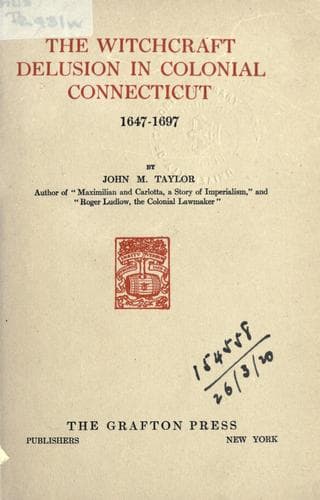
The Witchcraft Delusion in Colonial Connecticut (1647-1697) — John Shaqi
The Witchcraft Delusion in Colonial Connecticut (1647-1697)Taylor, John M. (John Metcalf)
History
The Witchcraft Delusion in Colonial Connecticut (1647-1697)
Taylor, John M. (John Metcalf)
Connecticut -- History -- Colonial period, ca. 1600-1775; Witchcraft -- Connecticut -- History
"Within the compass of two years (1645-7), near upon three hundred
witches were arraigned, and the major part of them executed in Essex and
Suffolk only. Scotland swarms with them more and more, and persons of
good quality are executed daily."
Scotland set its seal on witchcraft as a crime by an act of its
parliament so early as 1563, amended in 1649. The ministers were the
inquisitors and persecutors. They heard the confessions, and inflicted
the tortures, and their cruelties were commensurate with the hard and
fast theology that froze the blood of mercy in their veins.
The trials were often held by special commissions issued by the privy
council, on the petition of a presbytery or general assembly. It was
here that those terrible instruments of torture, the caschielawis, the
lang irnis, the boot and the pilliewinkis, were used to wring
confessions from the wretched victims. It is all a strange and gruesome
story of horrors told in detail in the state trial records, and
elsewhere, from the execution of Janet Douglas--Lady Glammis--to that of
the poor old woman at Dornoch who warmed herself at the fire set for her
burning. So firmly seated in the Scotch mind was the belief in
witchcraft as a sin and crime, that when the laws against it were
repealed in 1736, Scotchmen in the highest stations of church and state
remonstrated against the repeal as contrary to the law of God; and
William Forbes, in his "Institutes of the Law of Scotland," calls
witchcraft "that black art whereby strange and wonderful things are
wrought by a power derived from the devil."
This glance at what transpired on the continent and in England and
Scotland is of value, in the light it throws on the beliefs and
convictions of both Pilgrim and Puritan--Englishmen all--in their new
domain, their implicit reliance on established precedents, their
credulity in witchcraft matters, and their absolute trust in scriptural
and secular authority for their judicial procedure, and the execution of
the grim sentences of the courts, until the revolting work of the
accuser and the searcher, and the delusion of the ministers and
magistrates aflame with mistaken zeal vanished in the sober
afterthought, the reaction of the public mind and conscience, which at
last crushed the machinations of the Devil and his votaries in high
places.
CHAPTER IV
"Hence among all the superstitions that have 'stood over' from primeval
ages, the belief in witchcraft has been the most deeply rooted and the
most tenacious of life. In all times and places until quite lately,
among the most advanced communities, the reality of witchcraft has been
accepted without question, and scarcely any human belief is supported by
so vast a quantity of recorded testimony."
Public-domain text, read in full here on John Shaqi.
Reviews
Reviews
No reviews yet
Be the first to share your thoughts on this work.
Join the Discussion
Join the discussion
Sign in to leave a comment or review.
Sign InorCreate an account