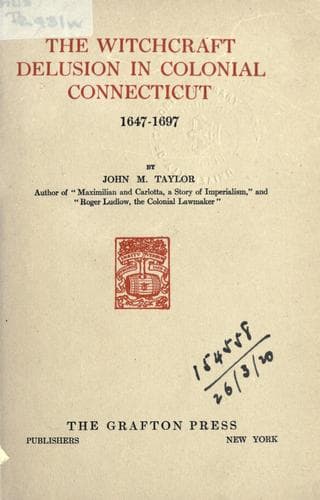
The Witchcraft Delusion in Colonial Connecticut (1647-1697)Taylor, John M. (John Metcalf)
History
The Witchcraft Delusion in Colonial Connecticut (1647-1697)
Taylor, John M. (John Metcalf)
Connecticut -- History -- Colonial period, ca. 1600-1775; Witchcraft -- Connecticut -- History
A few words about the tragedy at Salem are relevant and essential. They
are written because it was the last outbreak of epidemic demonopathy
among the civilized peoples; it has been exploited by writers abroad,
who have left the dreadful record of the treatment of the delusion in
their own countries in the background; it was accompanied in some degree
by like manifestations and methods of suppression in sister colonies; it
was fanned into flames by men in high station who reveled in its
merciless extirpation as a religious duty, and eased their consciences
afterwards by contrition, confession and remorse, for their valiant
service in the army of the theological devil; and especially for the
contrasts it presents to the more cautious and saner methods of
procedure that obtained in the governments of Connecticut and New Haven
at the apogee of the delusion.
What say the historians and scholars, some of whose ancestors witnessed
or participated in the tragedies, and whose acquaintance with the facts
defies all challenge?
"It is on the whole the most gruesome episode in American history, and
it sheds back a lurid light upon the long tale of witchcraft in the
past." (_Fiske's New France and New England_, 195.)
"The sainted minister in the church; the woman of the scarlet letter in
the market place! What imagination would have been irreverent enough to
surmise that the same scorching stigma was on them both." (_Scarlet
Letter_, HAWTHORNE.)
"We are made partners in parish and village feuds. We share in the
chimney corner gossip, and learn for the first time how many mean and
merely human motives, whether consciously or unconsciously, gave impulse
and intensity to the passions of the actors in that memorable tragedy
which dealt the death blow in this country to the belief in Satanic
compacts." (_Among my Books--Witchcraft_, p. 142, LOWELL.)
"The tragedy was at an end. It lasted about six months, from the first
accusations in March until the last executions in September.... It was
an epidemic of mad superstitious fear, bitterly to be regretted, and a
stain upon the high civilization of the Bay Colony." (_Historic Towns of
New England, Salem_, p. 148, LATIMER.)
What was done at Salem, when the tempest of unreason broke loose? Who
were the chief actors in it? This was done. From the first accusation in
March, 1692, to the last execution in September, 1692, nineteen persons
were hanged and one man was pressed to death[D] (_no witch was ever
burned in New England_), hundreds of innocent men and women were
imprisoned, or fled into exile or hiding places, their homes were broken
up, their estates were ruined, and their families and friends were left
in sorrow, anxiety, and desolation; and all this terrorism was wrought
at the instance of the chief men in the communities, the magistrates,
and the ministers.
[Footnote D: Fifty-five persons suffered torture, and twenty were
executed before the delusion ended. _Ency. Americana_ (Vol. 16,
"Witchcraft").]
Public-domain text, read in full here on John Shaqi.
Reviews
Reviews
No reviews yet
Be the first to share your thoughts on this work.
Join the Discussion
Join the discussion
Sign in to leave a comment or review.
Sign InorCreate an account