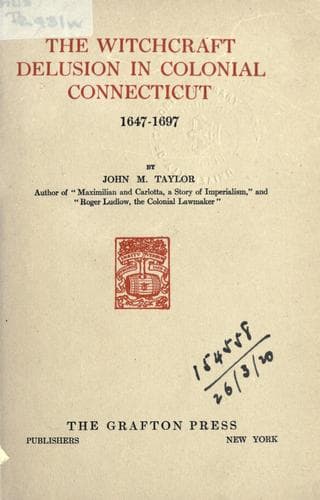
The Witchcraft Delusion in Colonial Connecticut (1647-1697)Taylor, John M. (John Metcalf)
History
The Witchcraft Delusion in Colonial Connecticut (1647-1697)
Taylor, John M. (John Metcalf)
Connecticut -- History -- Colonial period, ca. 1600-1775; Witchcraft -- Connecticut -- History
"Considering the fact that the exodus of Puritans to New England
occurred during the reign of Charles I, while the persecutions for
witchcraft were increasing toward a maximum in the mother country, it is
rather strange that so few cases occurred in the New World." _New France
and New England_ (pp. 136-144), FISKE.
The forefathers believed in witchcraft--entering into compacts with the
Devil--and in all its diabolical subtleties. They had cogent reasons for
their belief in example and experience. They set it down in their codes
as a capital offense. They found, as has been shown abundant authority
in the Bible and in the English precedents. They anchored their criminal
codes as they did their theology in the wide and deep haven of the Old
Testament decrees and prophecies and maledictions, and doubted not that
"the Scriptures do hold forth a perfect rule for the direction and
government of all men in all duties which they are to perform to God and
men."
Massachusetts, Connecticut, and New Haven, early in their history
enacted these capital laws:
In Massachusetts (1641):
"Witchcraft which is fellowship by covenant with a familiar spirit to
be punished with death."
"Consulters with witches not to be tolerated, but either to be cut off
by death or banishment or other suitable punishment." (_Abstract New
England Laws_, 1655.)
In Connecticut (1642):
"If any man or woman be a witch--that is, hath or consulteth with a
familiar spirit--they shall be put to death." Exodus xxii, 18; Leviticus
xx, 27; Deuteronomy xviii, 10, 11. (_Colonial Records of Connecticut_,
Vol. I, p. 77).
In New Haven (1655):
"If any person be a witch, he or she shall be put to death according to"
Exodus xxii, 18; Leviticus xx, 27; Deuteronomy xviii, 10, 11. (_New
Haven Colonial Records_, Vol. II, p. 576, Cod. 1655).
These laws were authoritative until the epidemic had ceased.
Witches were tried, condemned, and executed with no question as to due
legal power, in the minds of juries, counsel, and courts, until the hour
of reaction came, hastened by doubts and criticisms of the sources and
character of evidence, and the magistrates and clergy halted in their
prosecutions and denunciations of an alleged crime born of delusion, and
nurtured by a theology run rampant.
"They had not been taught to question the wisdom or the humanity of
English criminal law." (_Blue Laws--True and False_, p. 15, TRUMBULL.)
Here and there in New England, following the great immigration from Old
England, from 1630-40, during the Commonwealth, and to the Restoration,
several cases of witchcraft occurred, but the mania did not set its
seal on the minds of men, and inspire them to run amuck in their frenzy,
until the days of the swift onset in Massachusetts and Connecticut in
1692, when the zenith of Satan's reign was reached in the Puritan
colonies.
Public-domain text, read in full here on John Shaqi.
Reviews
Reviews
No reviews yet
Be the first to share your thoughts on this work.
Join the Discussion
Join the discussion
Sign in to leave a comment or review.
Sign InorCreate an account