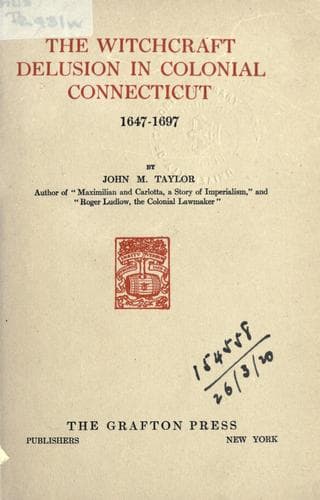
The Witchcraft Delusion in Colonial Connecticut (1647-1697)Taylor, John M. (John Metcalf)
History
The Witchcraft Delusion in Colonial Connecticut (1647-1697)
Taylor, John M. (John Metcalf)
Connecticut -- History -- Colonial period, ca. 1600-1775; Witchcraft -- Connecticut -- History
How may this story best be told? Clearly, so far as may be, in the very
words of the actors in those tragic scenes, in the words of the minister
and magistrate, the justice and the juryman, the accuser and the
accused, and the searcher. Into this court of inquiry come all these
personalities to witness the sorrowful march of the victims to the
scaffold or to exile, or to acquittal and deliverance with the after
life of suspicion and social ostracism.
The spectres of terror did not sit alone at the firesides of the poor
and lowly: they stalked in high places, and were known of men and women
of the first rank in education and the social virtues, and of greatest
influence in church and state.
Of this fact there is complete demonstration in a glance at the
dignitaries who presided at one of the earliest witchcraft trials--men
of notable ancestry, of learning, of achievements, leaders in colonial
affairs, whose memories are honored to this day.
These were the magistrates at a session entitled "A particular courte in
Hartford upon the tryall of John Carrington and his wife 20th Feb., 1662"
(See _Rec. P.C._, 2: 17): Edw. Hopkins Esqr., Gournor John Haynes Esqr.
Deputy, Mr. Wells, Mr. Woolcott, Mr. Webster, Mr. Cullick, Mr. Clarke.
This court had jurisdiction over misdemeanors, and was "aided by a
jury," as a close student of colonial history, the late Sherman W.
Adams, quaintly says in one of his historical papers. These were the
jurymen:
Mr. Phelps John White John More
Mr. Tailecoat Will Leawis Edw. Griswold
Mr. Hollister Sam. Smith Steph. Harte
Daniel Milton John Pratt Theo. Judd
Before this tribunal--representative of the others doing like service
later--made up of the foremost citizens, and of men in the ordinary
walks of life, endowed with hard common sense and presumably inspired
with a spirit of justice and fair play, came John Carrington and his
wife Joan of Wethersfield, against whom the jury brought in a verdict of
guilty.
It must be clearly borne in mind that all these men, in this as in all
the other witchcraft trials in Connecticut, illustrious or
commonplace--as are many of their descendants whose names are written on
the rolls of the patriotic societies in these days of ancestral
discovery and exploitation--were absolute believers in the powers of
Satan and his machinations through witchcraft and the evidence then
adduced to prove them, and trained to such credulity by their education
and experience, by their theological doctrines, and by the law of the
land in Old England, but still clothed upon with that righteousness
which as it proved in the end made them skeptical as to certain alleged
evidences of guilt, and swift to respond to the calls of reason and of
mercy when the appeals were made to their calm judgment and second
thought as to the sins of their fellowmen.
Public-domain text, read in full here on John Shaqi.
Reviews
Reviews
No reviews yet
Be the first to share your thoughts on this work.
Join the Discussion
Join the discussion
Sign in to leave a comment or review.
Sign InorCreate an account