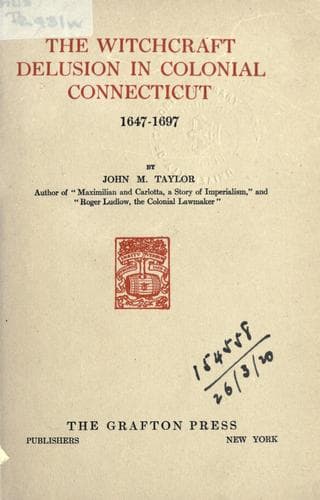
The Witchcraft Delusion in Colonial Connecticut (1647-1697)Taylor, John M. (John Metcalf)
History
The Witchcraft Delusion in Colonial Connecticut (1647-1697)
Taylor, John M. (John Metcalf)
Connecticut -- History -- Colonial period, ca. 1600-1775; Witchcraft -- Connecticut -- History
In no way can the truth be so clearly set forth, the real character of
the evidence be so justly appreciated upon which the convictions were
had, as from the depositions and the oral testimony of the witnesses
themselves. They are lasting memorials to the credulity and
superstition, and the religious insanity which clouded the senses of the
wisest men for a time, and to the malevolence and satanic ingenuity of
the people who, possessed of the devil accused their friends and
neighbors of a crime punishable by death.
Nor is this dark chapter in colonial history without its flashes of
humor and ridiculousness, as one follows the absurd and unbridled
testimonies which have been chosen as completely illustrative of the
whole series in the years of the witchcraft nightmare. They are in part
cited here, for the sake of authenticity and exactness, as written out
in the various court records and depositions, published and unpublished,
in the ancient style of spelling, and are worthy the closest study for
many reasons.
It will, however, clear the way to a better understanding of the unique
testimonies of the witch witnesses, if there be first presented the
authoritative reasons for the examination of a witch, coupled with a
summary of the lawful tests of innocence or guilt. They are in the
handwriting of William Jones, a Deputy Governor of Connecticut and a
member of the court at some of the trials.
GROUNDS FOR EXAMINATION OF A WITCH
"1. Notorious defamacon by ye common report of the people a ground of
suspicion.
"2. Second ground for strict examinacon is if a fellow witch gave
testimony on his examinacon or death yt such a pson is a witch, but this
is not sufficient for conviccon or condemnacon.
"3. If after cursing, there follow death or at least mischiefe to ye
party.
"4. If after quarrelling or threatening a prsent mischiefe doth follow
for ptye's devilishly disposed after cursing doe use threatnings, & yt
alsoe is a grt prsumcon agt y.
"5. If ye pty suspected be ye son or daughter, the serv't or familiar
friend, neer neighbors or old companion of a knowne or convicted witch
this alsoe is a prsumcon, for witchcraft is an art yt may be larned &
covayd from man to man & oft it falleth out yt a witch dying leaveth som
of ye aforesd heires of her witchcraft.
"6. If ye pty suspected have ye devills mark for t'is thought wn ye
devill maketh his covent with y he alwayess leaves his mark behind him
to know y for his owne yt is, if noe evident reason in can be given
for such mark.
"7. Lastly if ye pty examined be unconstant & contrary to himselfe in
his answers.
"Thus much for examinacon wch usually is by Q. & some tymes by torture
upon strong & grt presumcon.
"For conviccon it must be grounded on just and sufficient proofes. The
proofes for conviccon of 2 sorts, 1, Some be less sufficient, some more
sufficient.
Public-domain text, read in full here on John Shaqi.
Reviews
Reviews
No reviews yet
Be the first to share your thoughts on this work.
Join the Discussion
Join the discussion
Sign in to leave a comment or review.
Sign InorCreate an account