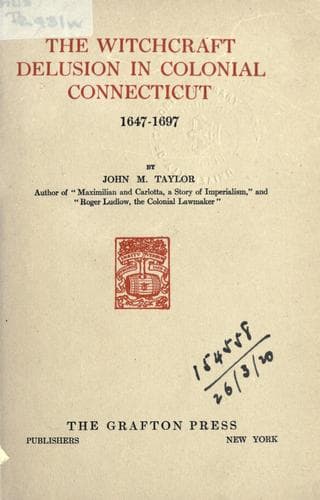
The Witchcraft Delusion in Colonial Connecticut (1647-1697)Taylor, John M. (John Metcalf)
History
The Witchcraft Delusion in Colonial Connecticut (1647-1697)
Taylor, John M. (John Metcalf)
Connecticut -- History -- Colonial period, ca. 1600-1775; Witchcraft -- Connecticut -- History
It is, however, with only one of King Hammurabi's wise laws that this
inquiry has to do, and it is this:
"If a man has placed an enchantment upon a man, and has not justified
himself, he upon whom the enchantment is placed to the Holy River
(Euphrates) shall go; into the Holy River he shall plunge. If the Holy
River holds (drowns) him he who enchanted him shall take his house. If
on the contrary, the man is safe and thus is innocent, the wizard loses
his life, and his house."
Or, as another translation has it:
"If a man ban a man and cast a spell on him--if he cannot justify it he
who has banned shall be killed."
"If a man has cast a spell on a man and has not justified it, he on whom
the spell has been thrown shall go to the River God, and plunge into the
river. If the River God takes him he who has banned him shall be saved.
If the River God show him to be innocent, and he be saved, he who banned
him shall be killed, and he who plunged into the river shall take the
house of him who banned him."
There can be no more convincing evidence of the presence and power of
the great witchcraft superstition among the primitive races than this
earliest law; and it is to be especially noted that it prescribes one of
the very tests of guilt--the proof by water--which was used in another
form centuries later, on the continent, in England and New England, at
Wurzburg and Bonn, at Rouen, in Suffolk, Essex and Devon, and at Salem
and Hartford and Fairfield, when "the Devil starteth himself up in the
pulpit, like a meikle black man, and calling the row (roll) everyone
answered, Here!"
CHAPTER II
"To deny the possibility, nay actual evidence of witchcraft and sorcery,
is at once to flatly contradict the revealed word of God in various
passages both of the Old and New Testaments." _Blackstone's
Commentaries_ (Vol. 4, ch. 4, p. 60).
"It was simply the natural result of Puritanical teaching acting on the
mind, predisposing men to see Satanic influence in life, and
consequently eliciting the phenomena of witchcraft." LECKY's
_Rationalism in Europe_ (Vol. I, p. 123).
Witchcraft's reign in many lands and among many peoples is also attested
in its remarkable nomenclature. Consider its range in ancient, medieval
and modern thought as shown in some of its definitions: Magic, sorcery,
soothsaying, necromancy, astrology, wizardry, mysticism, occultism, and
conjuring, of the early and middle ages; compacts with Satan, consorting
with evil spirits, and familiarity with the Devil, of later times; all
at last ripening into an epidemic demonopathy with its countless victims
of fanaticism and error, malevolence and terror, of persecution and
ruthless sacrifices.
Public-domain text, read in full here on John Shaqi.
Reviews
Reviews
No reviews yet
Be the first to share your thoughts on this work.
Join the Discussion
Join the discussion
Sign in to leave a comment or review.
Sign InorCreate an account