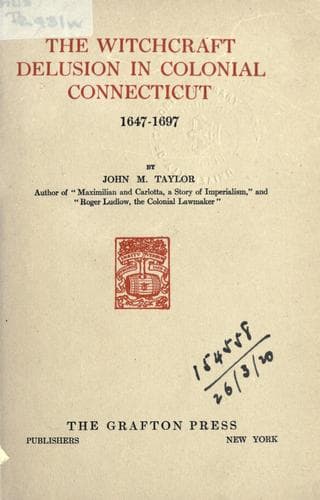
The Witchcraft Delusion in Colonial Connecticut (1647-1697)Taylor, John M. (John Metcalf)
History
The Witchcraft Delusion in Colonial Connecticut (1647-1697)
Taylor, John M. (John Metcalf)
Connecticut -- History -- Colonial period, ca. 1600-1775; Witchcraft -- Connecticut -- History
It is still most potent in its evil, grotesque, and barbaric forms, in
Fetichism, Voodooism, Bundooism, Obeahism, and Kahunaism, in the devil
and animal ghost worship of the black races, completely exemplified in
the arts of the Fetich wizard on the Congo; in the "Uchawi" of the
Wasequhha mentioned by Stanley; in the marriage customs of the Soudan
devil worshipers; in the practices of the Obeah men and women in the
Caribbees--notably their power in matters of love and business, religion
and war--in Jamaica; in the incantations of the kahuna in Hawaii; and in
the devices of the voodoo or conjure doctor in the southern states; in
the fiendish rites and ceremonies of the red men,--the Hoch-e-ayum of
the Plains Indians, the medicine dances of the Cheyennes and Arapahoes,
the fire dance of the Navajos, the snake dance of the Moquis, the sun
dance of the Sioux, in the myths and tales of the Cherokees; and it
rings in many tribal chants and songs of the East and West.
It lives as well, and thrives luxuriantly, ripe for the full vintage, in
the minds of many people to whom this or that trivial incident or
accident of life is an omen of good or evil fortune with a mysterious
parentage. Its roots strike deep in that strange element in human nature
which dreads whatsoever is weird and uncanny in common experiences, and
sees strange portents and dire chimeras in all that is unexplainable to
the senses. It is made most virile in the desire for knowledge of the
invisible and intangible, that must ever elude the keenest inquiry, a
phase of thought always to be reckoned with when imagination runs riot,
and potent in its effect, though evanescent as a vision the brain
sometimes retains of a dream, and as senseless in the cold light of
reason as Monna Sidonia's invocation at the Witches' Sabbath: (_Romance
of Leonardo da Vinci_, p. 97, MEREJKOWSKI.)
"Emen Hetan, Emen Hetan, Palu, Baalberi,
Astaroth help us Agora, Agora, Patrisa,
Come and help us."
"Garr-r: Garr-r, up: Don't knock
Your head: We fly: We fly:"
And who may count himself altogether free from the subtle power of the
old mystery with its fantastic imageries, when the spirit of unrest is
abroad? Who is not moved by it in the awesome stillness of night on the
plains, or in the silence of the mountains or of the somber forest
aisles; in wild winter nights when old tales are told; in fireside
visions as tender memories come and go? And who, when listening to the
echoes of the chambers of the restless sea when deep calleth unto deep,
does not hear amid them some weird and haunting refrain like Leland's
sea song?
"I saw three witches as the wind blew cold
In a red light to the lee;
Bold they were and overbold
As they sailed over the sea;
Calling for One Two Three;
And I think I can hear
It a ringing in my ear,
A-calling for the One, Two, Three."
Public-domain text, read in full here on John Shaqi.
Reviews
Reviews
No reviews yet
Be the first to share your thoughts on this work.
Join the Discussion
Join the discussion
Sign in to leave a comment or review.
Sign InorCreate an account